
Ceiling Fans with Lights for Sloped and Vaulted Ceilings: Compatibility and Fit
A ceiling fan with light is suitable for a sloped or vaulted ceiling only when the measured ceiling angle is within the approved range of the fan’s hanging system or a compatible slope adapter, the fan can hang plumb with adequate clearance, and the mounting structure can support a ceiling fan’s dynamic load. Steeper or higher ceilings often require a slope-compatible mount and a downrod, but the exact angle limit and downrod options are model-specific, so verify them against the fan manufacturer’s installation requirements rather than relying on one universal pitch value.
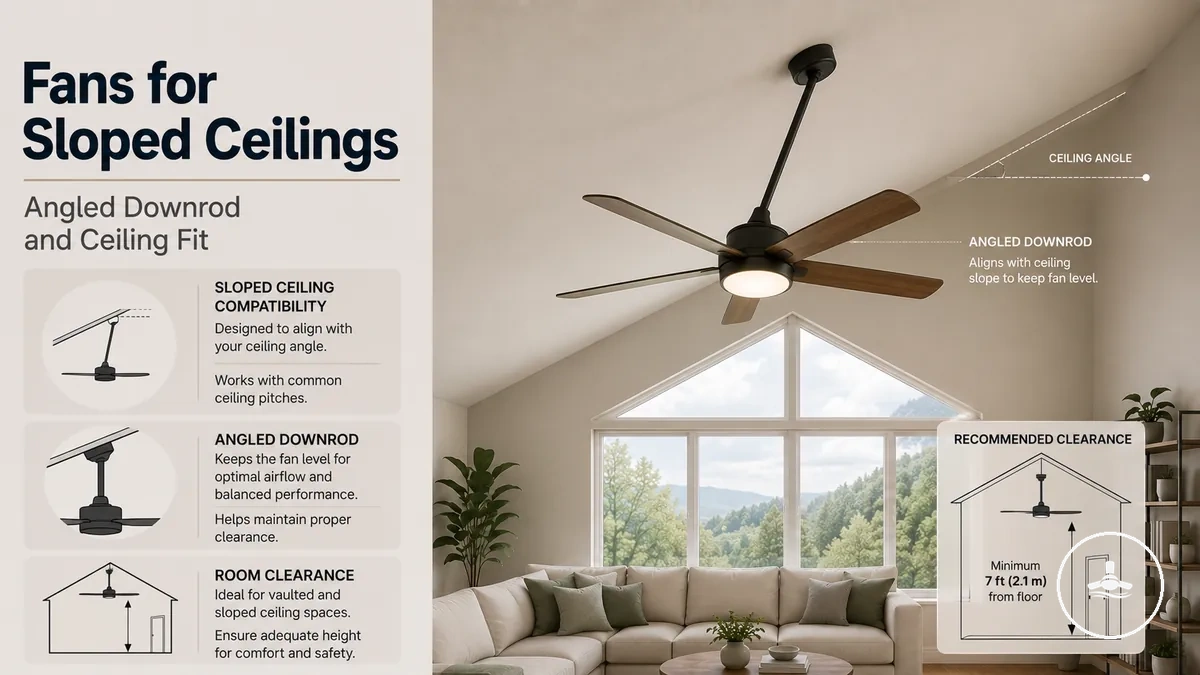
Compatibility decision check
Use these five gates in order. A configuration is ready for model-specific verification only when every gate is satisfied.
- 1. Ceiling angle Pass: the measured slope is within the fan mount’s stated range or an approved slope adapter’s range. If not: choose a compatible adapter or a different fan/mounting system.
- 2. Hanging geometry Pass: the downrod and fan can hang vertically while the canopy and hanger work correctly on the slope. If not: revise the slope-mount arrangement before considering style or controls.
- 3. Structural support Pass: the bracket is fixed to framing or another support system suitable for ceiling-fan loads. If not: the location is not installation-ready.
- 4. Blade and light clearance Pass: the complete blade sweep and the light kit meet the fan’s required clearances from the ceiling, walls, beams and occupied space. If not: adjust fan size, downrod position or mounting location.
- 5. Room performance Pass: blade span, airflow capability and light output suit the room dimensions and use. If not: select a configuration that better matches the room rather than compensating with mounting hardware.
Decision rule: slope compatibility, structural support and clearance are prerequisites; room airflow and lighting determine which compatible configuration is the better fit.
On an angled ceiling, the mounting system, downrod, support and clearances work as one system. The sections below separate those relationships so you can verify compatibility before narrowing the choice by room size, airflow and lighting.
How ceiling fans with lights work on sloped and vaulted ceilings: compatibility fundamentals and constraints
Ceiling geometry changes the relationship between the mounting point, the rotating blade plane and the light position. The fan itself should still operate with its motor and blade plane correctly oriented; the slope is handled by the hanging system and, when needed, a compatible adapter or downrod. The main compatibility factors are easier to assess when their effects are separated.
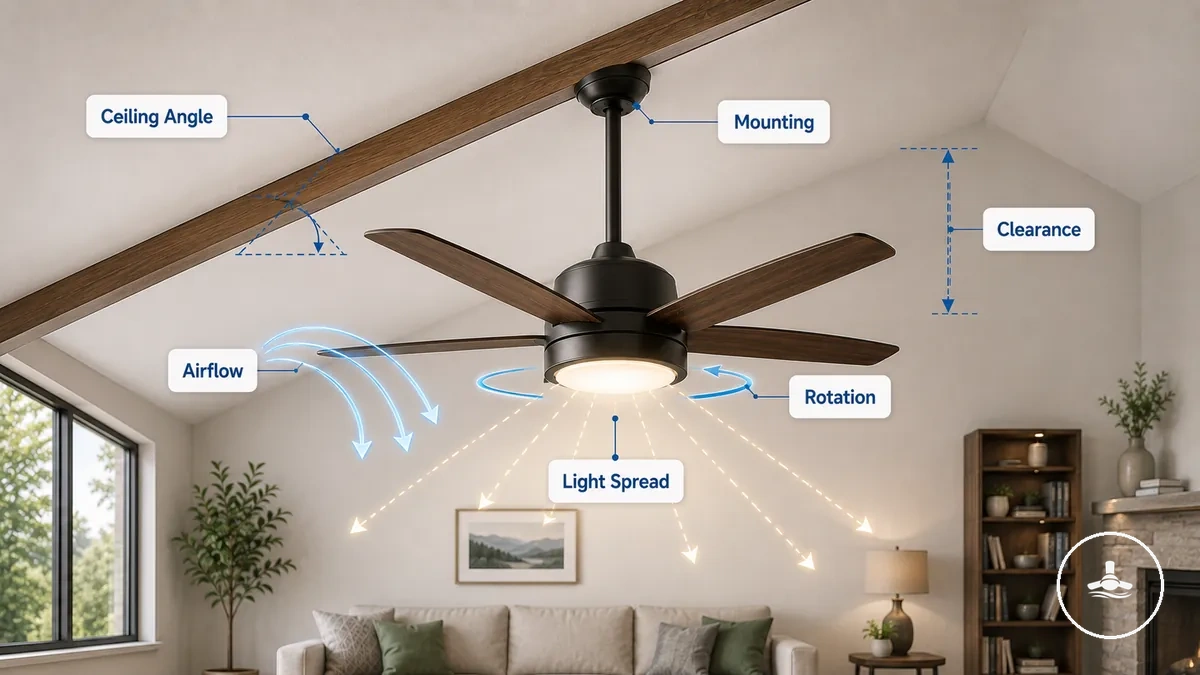
What the ceiling geometry changes
| Factor | Attribute to verify | Practical effect |
|---|---|---|
| Ceiling slope | Mount or adapter angle range | Determines whether the hanging hardware can accommodate the ceiling plane while allowing the fan to hang correctly. |
| Hanging system | Plumb suspension and compatible canopy/hanger | Supports stable operation and prevents the fan body from simply following the ceiling angle. |
| Downrod position | Vertical drop from the sloped surface | Changes blade-to-ceiling clearance and where the fan sits within the room volume. |
| Blade sweep | Closest clearance around the full rotation path | Controls collision risk near the high and low sides of the slope, beams or walls. |
| Light kit | Fixture height and distribution | Affects headroom, visual comfort and how evenly light reaches the occupied area. |
These relationships explain why a fan described as suitable for a flat ceiling is not automatically suitable for a sloped one. For broader context on fan types, sizing and controls, see the ceiling fans with lights guide.
Ceiling angle limits and pitch requirements for safe ceiling fan installation with lights
There is no universal maximum ceiling angle that applies to every ceiling fan. The usable pitch is set by the fan’s hanging system and, where applicable, the approved slope adapter. Measure the actual ceiling angle and compare it with the stated range for the exact fan and mounting hardware before treating the installation as compatible.
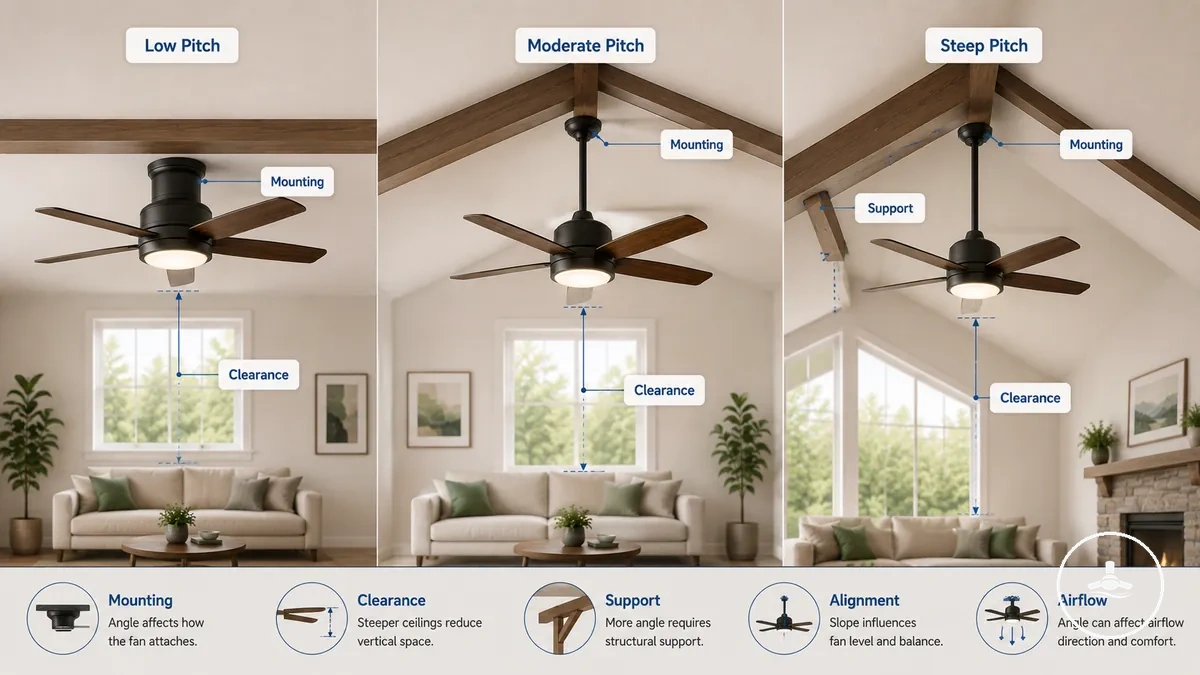
How to interpret the measured ceiling angle
| Measured condition | Compatibility value | Decision |
|---|---|---|
| Angle is within the fan’s standard hanging-mount range | Compatible in principle, subject to support and clearance | Continue to structural and clearance checks. |
| Angle exceeds the standard mount but falls within an approved adapter’s range | Conditionally compatible | Use the manufacturer-approved or explicitly compatible slope adapter and verify the required downrod arrangement. |
| Angle exceeds the approved mount/adapter range or the canopy cannot seat correctly | Not compatible with that mounting configuration | Select a different mounting system or fan rather than forcing the existing hardware to fit. |
If the ceiling pitch is expressed as rise over run rather than degrees, the geometric angle can be derived from that slope; however, the fan manufacturer’s stated angle range remains the compatibility value that matters. Check slope together with support and clearance using the clearance and mounting safety guidance.
Choosing mounting systems for sloped and vaulted ceiling fans with lights
An angled-ceiling mount, a slope adapter and a downrod are not interchangeable parts. The slope-compatible hanger deals with the ceiling angle; a downrod sets the vertical position of the fan. On many vaulted-ceiling installations, both functions are needed at the same time.
Mounting component roles
| Component | Primary function | Best-fit condition | Does not replace |
|---|---|---|---|
| Slope-capable hanging mount | Allows the fan/downrod to hang plumb while the ceiling plate or canopy meets an angled surface. | The measured slope is within the mount’s stated range. | Structural support or required blade clearance. |
| Angled-ceiling / slope adapter | Extends or changes the mounting geometry for slopes beyond the standard mount’s capability. | The fan and adapter are explicitly compatible and the measured slope falls within the adapter’s range. | A correctly sized downrod where extra drop is needed. |
| Downrod | Lowers the motor and blade plane below the ceiling. | A high or steep ceiling requires more separation for clearance or useful fan position. | Slope compatibility at the canopy/hanger. |
| Structural mounting support | Carries the fan’s static weight and dynamic operating loads. | Every installation. | Any of the geometry components above. |
The correct setup is therefore a compatible system, not a choice between “adapter” and “downrod” as if only one can be used.
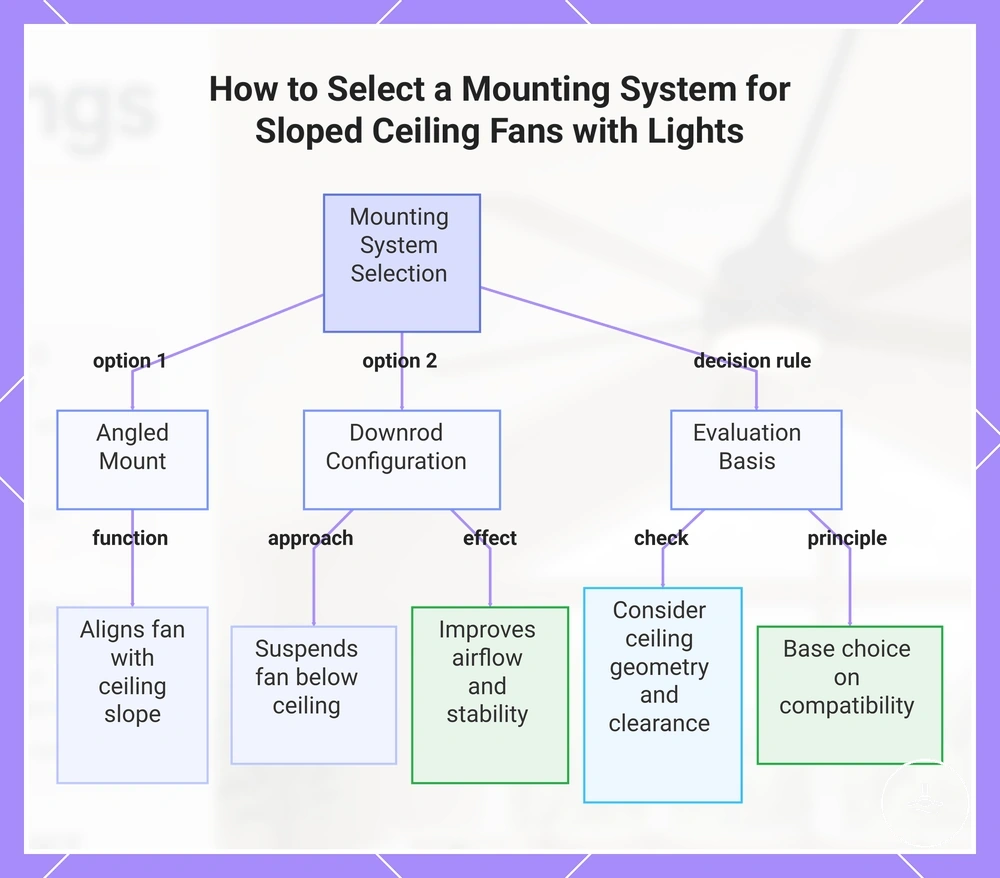
Angled ceiling mounts and adapter kits for sloped ceiling installation
An angled-ceiling mount or adapter changes how the hanger interfaces with the sloped surface so the fan can suspend vertically instead of tilting with the ceiling plane. Compatibility depends on the exact fan, canopy, hanger and adapter combination; a physically similar adapter should not be assumed to fit or carry the same load.
Compatibility rule
- Confirm the adapter is specified for the fan or hanging system being used.
- Confirm the measured ceiling angle is within the adapter’s stated range.
- Confirm the canopy can close correctly without binding the downrod or hanger.
- Treat persistent tilt, binding or incomplete canopy seating as a compatibility problem, not as a cosmetic issue.
A suitable adapter supports alignment; it does not correct weak structural support, insufficient blade clearance or an unsuitable downrod length.
Downrod selection and length adjustment for vaulted ceiling airflow and balance
Downrod length determines how far the fan is lowered from the mounting point. On a vaulted ceiling, a longer approved downrod can move the blade plane away from the sloping surface and closer to the occupied room volume, while a shorter downrod preserves more headroom. The correct length must satisfy both the fan’s approved downrod options and the required clearances.
Downrod selection logic
- Start with clearance: check the closest point between the full blade sweep and the sloped ceiling, beams and walls.
- Then check occupied height: lowering the fan must not create an unacceptable blade or light-fixture position above the floor.
- Then check room performance: in a very high space, lowering the fan can place airflow and light more effectively, but the fan’s own installation guidance still controls the permitted hardware.
Do not select a downrod from ceiling height alone. Angle, fan diameter, mounting location and clearance geometry determine how much drop is useful and safe.
Clearance and safety requirements for ceiling fans with lights on angled ceilings
Clearance on an angled ceiling is governed by the nearest point in the complete blade sweep, not by an average gap. Because one side of the ceiling can be closer to the blades than the other, check the full rotation envelope as well as the light kit’s lowest point. Exact minimum clearances can be model- and jurisdiction-dependent, so use the fan instructions and applicable local requirements rather than assuming one universal number.
Clearance checks that must be resolved
| Clearance relationship | What to verify | If the margin is inadequate |
|---|---|---|
| Blade ↔ sloped ceiling / roofline | Closest distance anywhere in the rotating blade path | Increase suitable drop, reduce fan diameter, relocate the mounting point or choose a more compatible configuration. |
| Blade ↔ wall / beam / built-in feature | Full blade radius plus required safety margin | Change fan size or mounting location rather than accepting a near-collision zone. |
| Blade ↔ occupied floor area | Installed blade height above the floor | Do not lengthen the downrod beyond the permitted safe position. |
| Light kit ↔ floor / furniture / sightline | Lowest point of the light assembly and practical headroom | Choose a shallower light kit or revise the fan’s vertical position if compatible. |
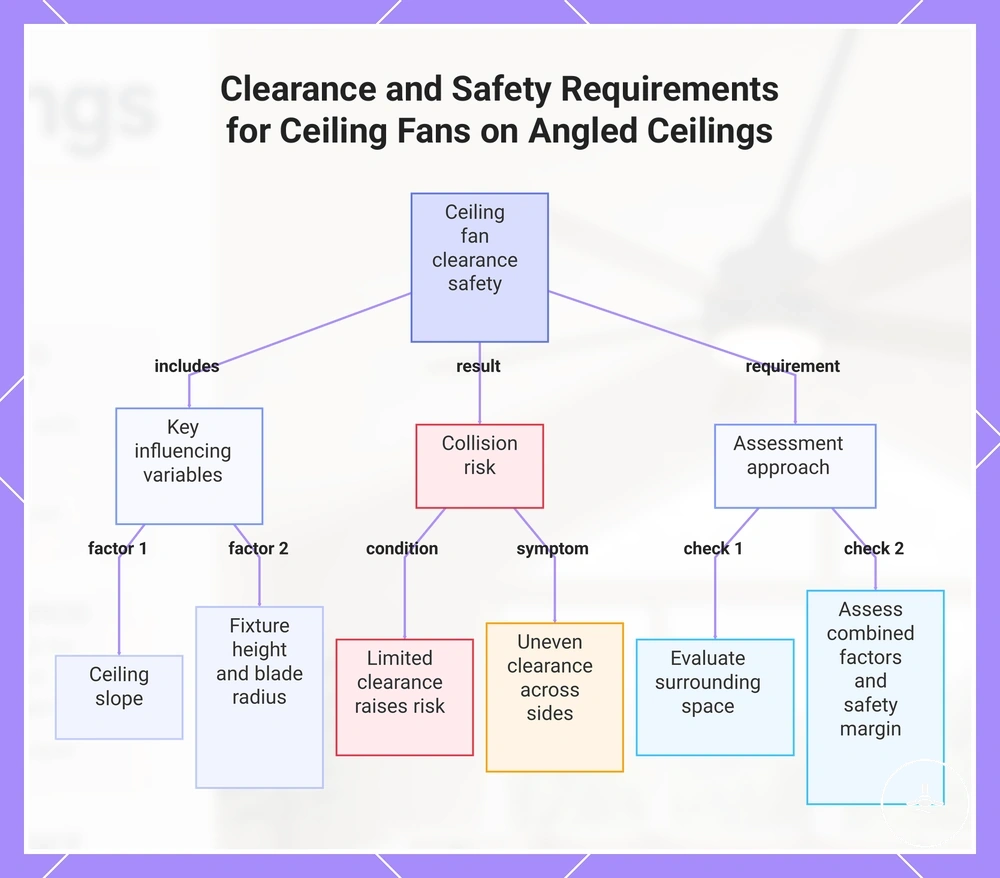
For a broader pre-installation review of these relationships, use the clearance and mounting safety checklist.
Blade clearance near sloped rooflines and angled ceiling geometry
The critical blade-clearance value is the smallest gap created as the blade tips sweep past the sloped ceiling and nearby obstacles. A single measurement directly below the mounting point can miss the tightest zone.
Blade-clearance verification
- Map the full blade radius around the mounting point.
- Identify the high side of the slope, beams, walls or other features that enter that radius.
- Evaluate the closest point, not the visually largest gap.
- Re-check clearance if fan diameter, downrod length or mounting position changes.
Changing one geometry variable changes the clearance relationship, so fan size and downrod length should be evaluated together rather than independently.
Lighting clearance and fixture positioning under vaulted ceilings
The light kit adds a second vertical and visual constraint below the fan. It should sit where it provides useful illumination without creating avoidable headroom, glare or obstruction problems.
Lighting fit therefore depends on both fixture depth and installed fan height, not on light output alone.
Installation considerations for vaulted and sloped ceiling fan setups
An installation is feasible only when the ceiling structure, mounting hardware, electrical supply and geometry all support the chosen fan. A ceiling that has enough physical space is not automatically installation-ready.
Pre-installation readiness checklist
- Structure: a suitable framing or support point is available for the fan mounting bracket.
- Mount: the hanger, canopy and any slope adapter support the measured ceiling angle.
- Downrod: the selected length is approved for the fan and produces acceptable blade and light positions.
- Clearance: the entire blade sweep remains clear of the sloped surface, beams, walls and occupied space.
- Electrical access: the supply and controls are suitable for the fan/light configuration. Fixed-wiring work should be handled by an appropriately licensed electrician in accordance with local requirements.
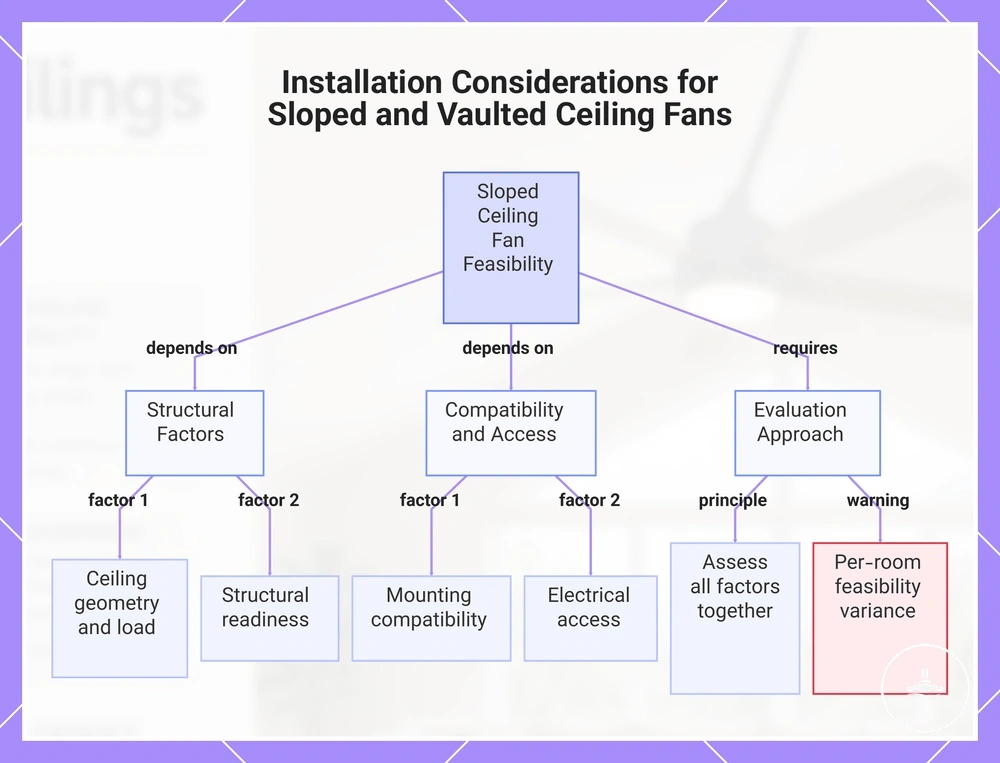
Electrical access and control requirements should be considered before the final product choice; see the wiring requirements for ceiling fan lights guide for that part of the decision.
Ceiling electrical box support and structural mounting requirements for angled installations
The structural support, not the wiring enclosure by itself, must carry the ceiling fan. The mounting bracket should be fixed to suitable framing or another support system intended for the fan’s weight and dynamic operating loads. An existing light-fitting junction point should not be assumed to provide fan support simply because the wiring is present.
Structural decision
- Ready
- The fan bracket can be secured to framing or a support system approved for ceiling-fan loading, and the chosen hardware matches the ceiling geometry.
- Needs assessment
- The support is concealed, its capacity is unknown, or the existing fixing was intended only for a light fitting.
- Not ready
- The bracket would rely on unsupported lining material or another fixing not intended to carry the fan’s operating loads.
On a sloped ceiling, support and geometry must be solved together: a strong fixing does not compensate for an incompatible hanger, and a slope adapter does not compensate for weak support.
Selecting the right ceiling fan with light configuration for sloped and vaulted spaces
Once the installation passes the angle, support and clearance checks, selection shifts to the room: fan diameter, airflow capability, downrod position and light output should match the space and how it is used. The best configuration is the one that satisfies the geometry first and then delivers the required comfort and lighting.
Configuration fit by room condition
| Room / ceiling condition | Priority criteria | Configuration direction |
|---|---|---|
| Sloped ceiling within the standard mount range, with generous clearance | Correct hanger, room-sized blade span, suitable light output | A fan explicitly rated for the measured slope may not need a separate steep-slope adapter. |
| Steeper slope beyond the standard mount range | Approved slope adapter, canopy fit, blade clearance | Choose a fan/adapter combination that explicitly covers the measured angle; add an approved downrod if the geometry requires more drop. |
| High vaulted ceiling | Useful fan height, airflow reach, service access and light position | Use an approved downrod length that brings the fan into a useful position without violating blade or light clearances. |
| Tight angled space | Blade radius and nearest-surface clearance | Prioritise a smaller compatible fan or a different mounting position; do not assume a flush/low-profile fan is slope-compatible. |
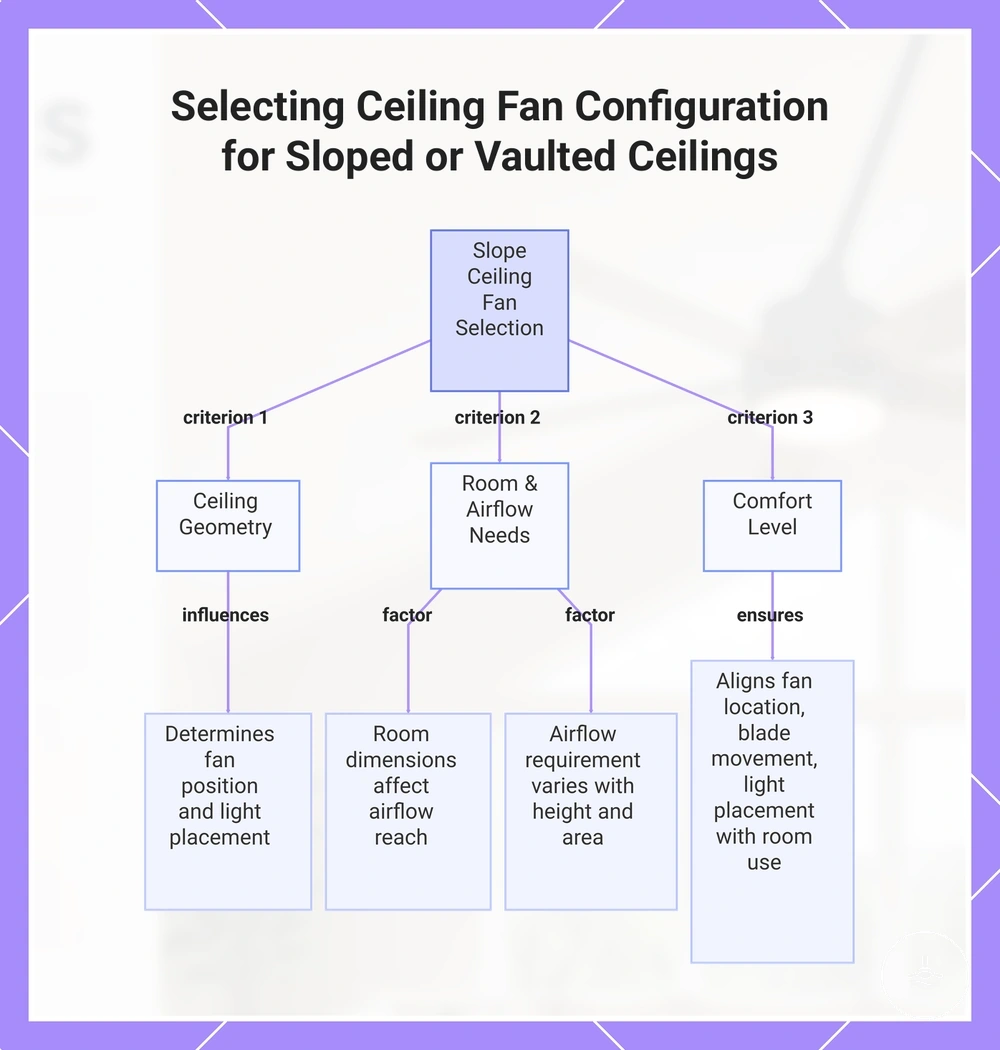
After geometry and mounting are resolved, use room area and required coverage to refine blade span and airflow. The blade span and room coverage guide covers that next decision layer.
Common mistakes when installing ceiling fans with lights on sloped and vaulted ceilings
Most problems on angled ceilings come from a mismatch between the ceiling geometry and one part of the mounting system. The symptom can appear as tilt, restricted clearance, poor fan position or an installation that cannot be securely supported.
Diagnostic guide for common fit mistakes
| Observed problem | Likely mismatch | Check | Decision |
|---|---|---|---|
| Fan/downrod does not hang plumb or canopy binds on the slope | Mount angle or adapter incompatibility | Compare the measured ceiling angle with the exact mount/adapter range and installation method. | Use compatible slope hardware; do not force the canopy or hanger into position. |
| Blade tip approaches the high side of the ceiling, a beam or wall | Insufficient clearance for the fan radius and drop | Evaluate the closest point across the full blade sweep. | Change approved downrod length, fan diameter or mounting location. |
| Fan sits too high to move air effectively in a tall vaulted room | Downrod too short for the room geometry | Compare installed blade height, room volume and the fan’s permitted downrod options. | Use a longer approved downrod only if all required clearances remain satisfied. |
| Fan or light sits too low | Excessive drop for the available occupied height | Check blade height, light-kit position and required local/manufacturer clearances. | Reduce the drop if the fan permits it, or select a different configuration. |
| Existing light point is treated as sufficient fan support | Structural support assumption | Verify how the bracket is fixed and whether the support is intended for fan loads. | Provide suitable structural support before installation. |
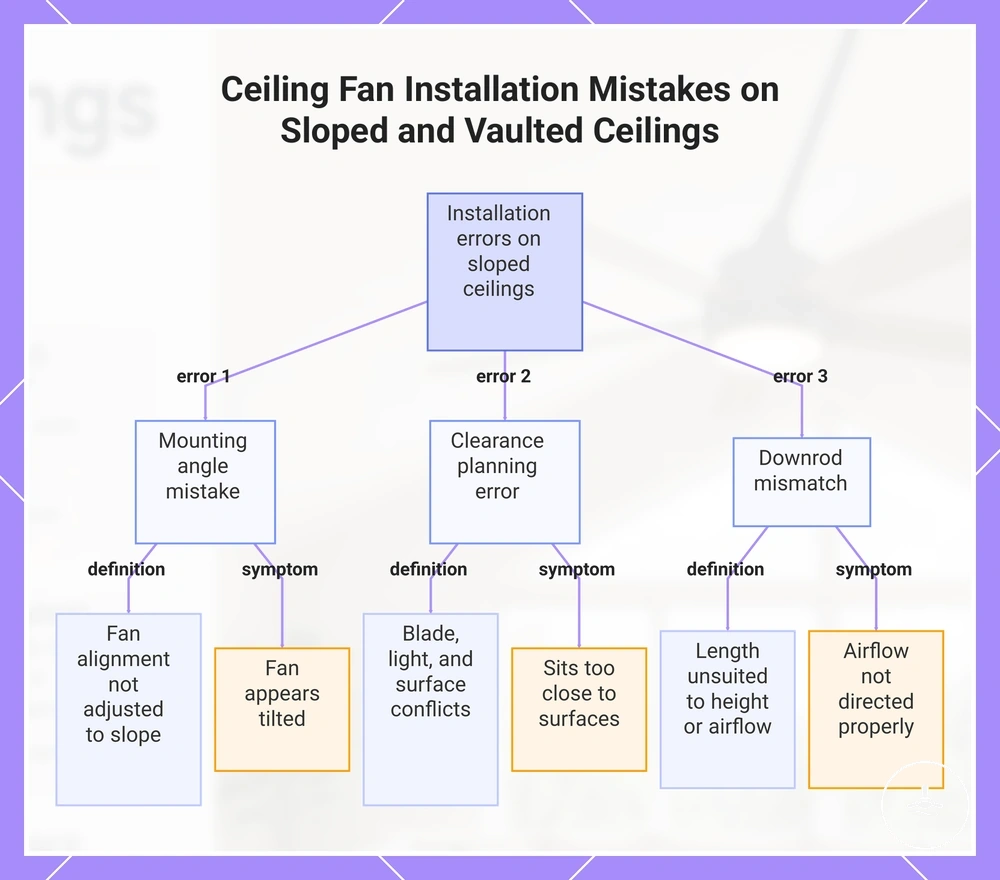
Correct the failed relationship rather than compensating elsewhere. A longer downrod cannot fix an incompatible slope mount, and a slope adapter cannot fix inadequate structural support.