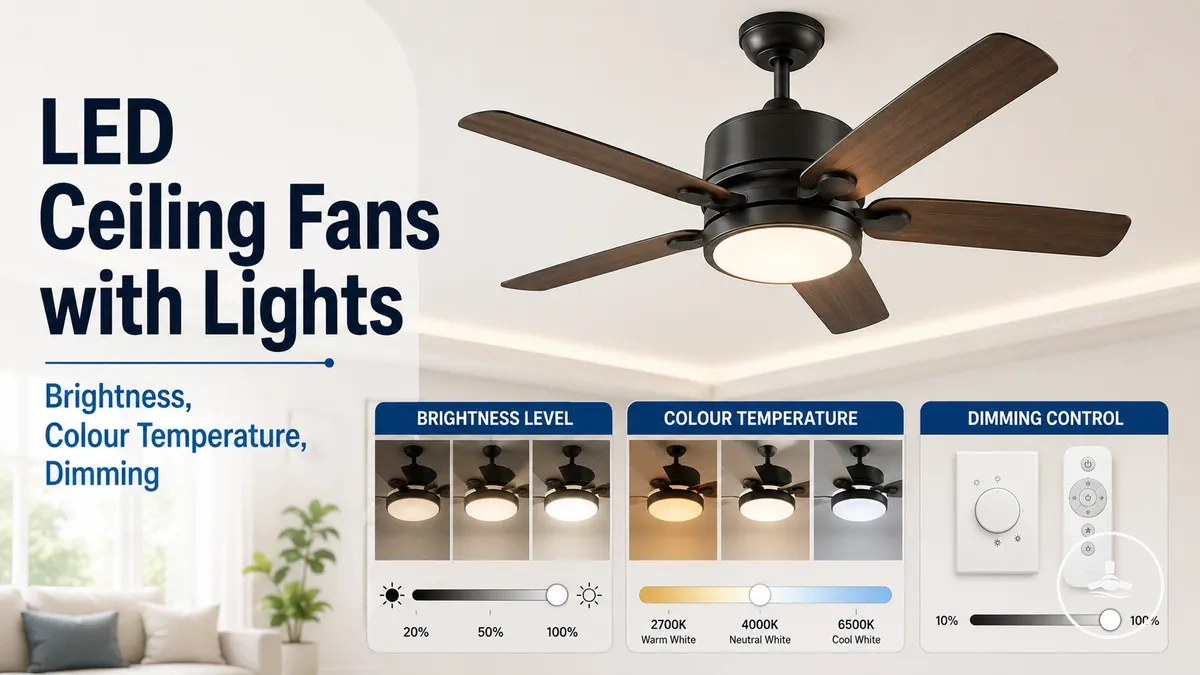
LED Ceiling Fans with Lights: Brightness, Colour Temperature and Dimming Performance
Judge an LED ceiling fan light with three separate attributes: lumens for light output, Kelvin (K) for colour appearance, and dimming compatibility between the LED system and its control. For room fit, compare lumen output and light distribution first, choose colour temperature for ambience, and treat dimming as a compatibility feature; wattage or a cooler colour temperature does not by itself mean more usable light.
Lighting-fit decision assistant
Choose the result you care about most. The assistant points to the attribute that should carry the most decision weight; it does not infer live product specifications.
Start with lumen output and light distribution. Use Kelvin for tone, not as a substitute for brightness, and verify dimming only when the LED module or lamp, driver and controller are designed to work together.
In practical terms: more lumens generally means more total light; lower Kelvin values look warmer, higher Kelvin values look cooler; and dimming can only reduce output within the system's supported range—it cannot raise the fixture above its maximum light output.
LED ceiling fan lighting combines illumination with a ceiling fan, so the useful choice is not a single “best” specification. Room size, ceiling height, surface reflectance, diffuser design and existing ambient light can change how the same lumen output feels, while colour temperature changes visual tone and compatible controls change adjustability. The sections below separate those relationships so that each specification is interpreted for the job it actually performs.
LED Lighting Systems in Ceiling Fans and Integrated Light Design Basics
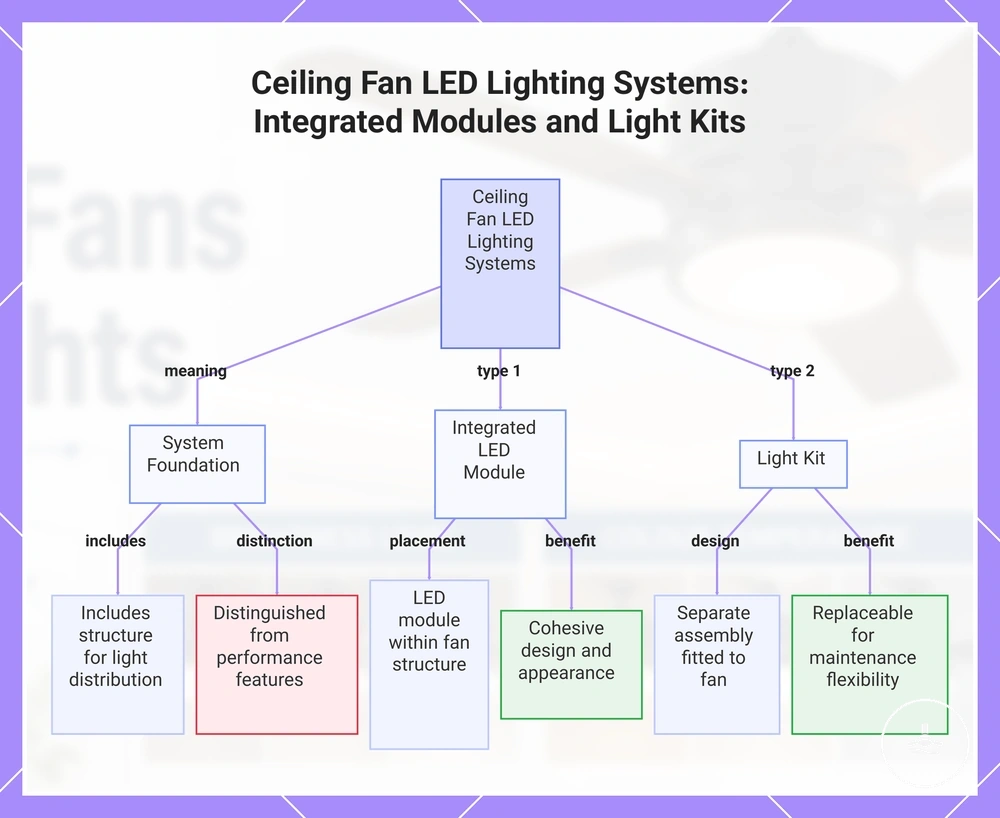
LED lighting systems in ceiling fans generally use either an integrated LED module built into the fixture or a separate light kit attached to a compatible fan. This configuration describes how the lighting is constructed and serviced; it does not, by itself, tell you how bright the light is, what colour temperature it uses, or whether it dims well.
Integrated LED module
Value: the light source is designed as part of the fan assembly.
- Typical advantage: compact, cohesive fixture design.
- Decision condition: check whether the LED module and driver are serviceable or replaceable for that model.
- Limitation: lamp-style upgrades are usually less flexible than with a replaceable-light arrangement.
Separate light kit
Value: the lighting assembly is a distinct component fitted to a compatible ceiling fan.
- Typical advantage: replacement or lighting changes may be easier when the kit or lamp is designed to be replaced.
- Decision condition: confirm fan-to-kit compatibility and the supported lamp or LED module.
- Limitation: compatibility is design-specific; a light kit is not automatically interchangeable between fan models.
For a broader explanation of the fixture architecture, see light kits and integrated lighting explained. When comparing either configuration, keep the design question separate from the performance questions that follow.
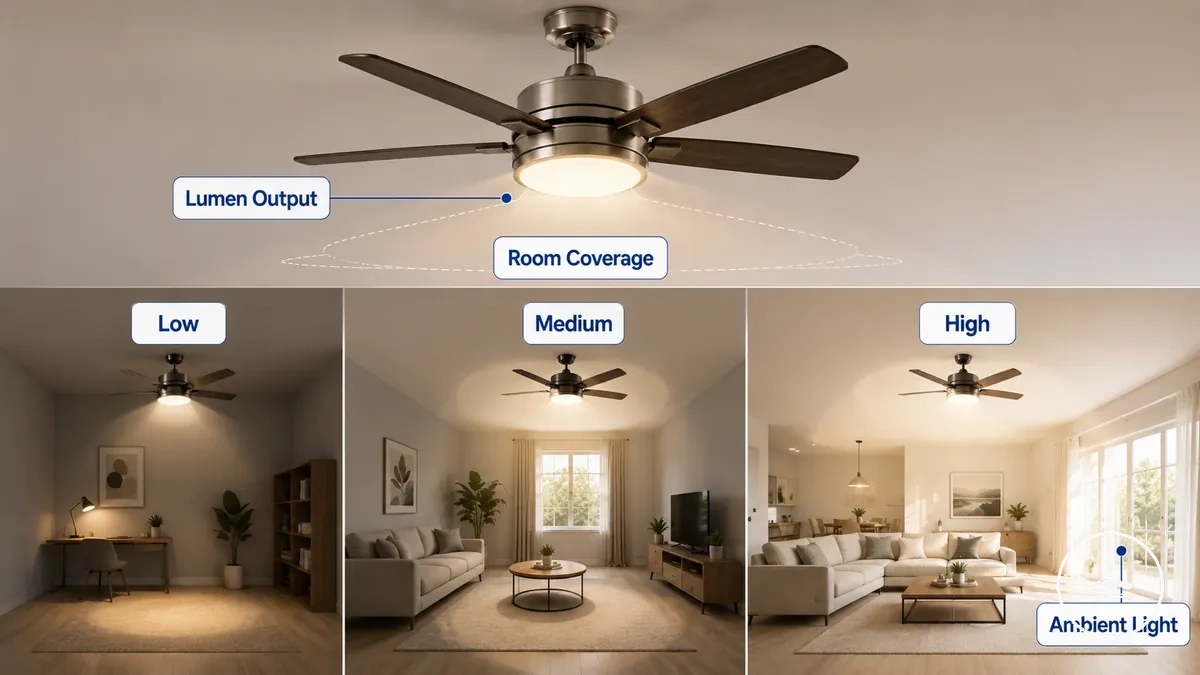
Brightness Levels and Lumen Output in LED Ceiling Fan Lights for Room Coverage
Lumens measure luminous flux—the total visible light emitted by the source. They are the most useful published value for comparing light quantity, whereas wattage measures electrical power input. A higher lumen rating generally provides more total light, but perceived brightness and room coverage still depend on how the fixture distributes that light and on the room itself.
| Attribute | What the value means | Decision implication |
|---|---|---|
| Lumen output | Total emitted visible light. | Use it as the primary published measure when comparing light quantity. |
| Light distribution | How the diffuser and optical design spread the available light. | Broader, more even distribution can improve usable coverage without changing the lumen rating. |
| Room conditions | Ceiling height, room size, darker or lighter surfaces, daylight and other lamps. | Higher-demand conditions can require more output or supplementary lighting for the same perceived result. |
| Wattage | Electrical power consumed by the lighting system. | Do not use wattage as a direct substitute for lumens when comparing LED brightness. |
- Need more room coverage? Prioritise higher lumen output together with broad, even distribution.
- Need softer general illumination? A lower output can be appropriate when the room is smaller, already has other light sources, or does not need strong task lighting.
- Unsure about the room requirement? Compare the ceiling-fan light with the room's other light sources rather than assuming the fan light must provide all illumination on its own.
For a room-specific example of how these factors interact, see living room brightness needs.
Colour Temperature in Ceiling Fan LEDs: Warm White vs Daylight and Ambience Effects
Colour temperature describes the appearance of white light and is expressed in kelvins (K). It is separate from lumen output: changing from warm white to daylight changes the visual tone, not automatically the amount of light emitted. Product naming varies, but the ranges below are commonly used as practical reference bands.
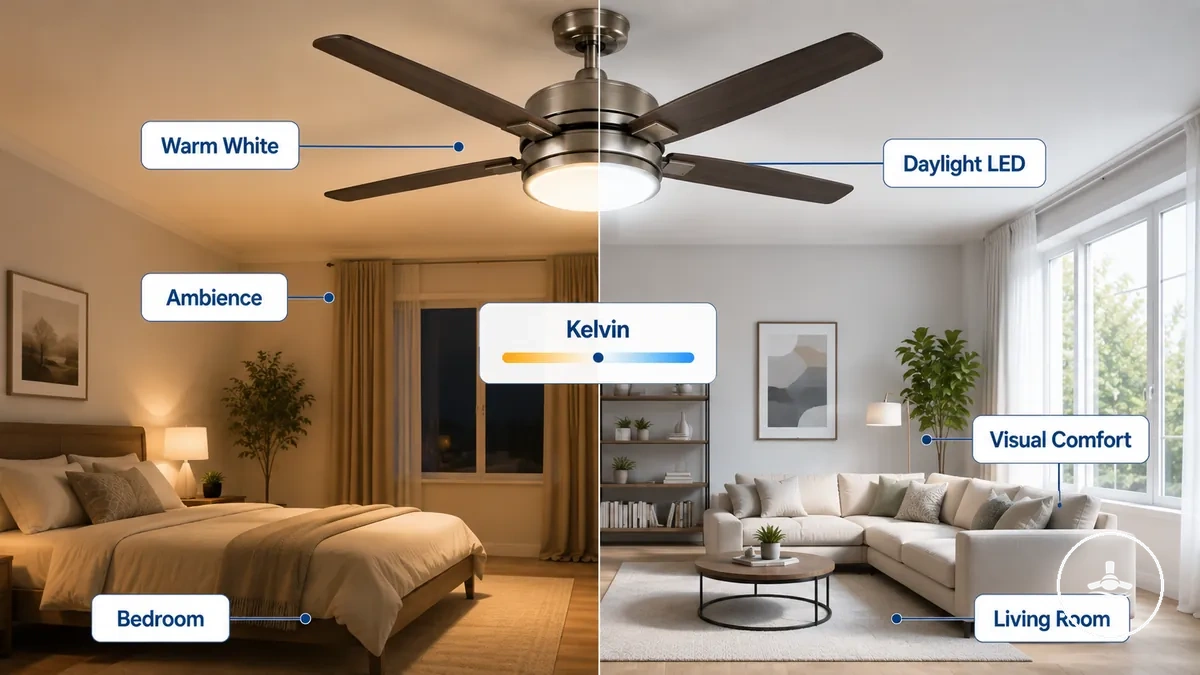
| Appearance | Common approximate CCT | Visual effect | Useful when |
|---|---|---|---|
| Warm white | 2700–3000 K | Softer, warmer appearance. | A relaxed or inviting atmosphere is the priority, such as many bedrooms and lounge areas. |
| Neutral / cool white | 3500–4000 K | More neutral to slightly cool appearance. | You want a balanced general-purpose tone without the warmth of 2700–3000 K or the cooler look of daylight. |
| Daylight / cooler white | 5000–6500 K | Crisper, cooler appearance. | You prefer a daylight-like visual impression or stronger perceived contrast for some tasks. |
The correct comparison is therefore tone versus room use, not warm versus “dim” or daylight versus “bright”. For sleeping spaces, see bedroom lighting needs for a more specific room context.
Dimming Behaviour in Ceiling Fan LED Lights and Perceived Brightness Control
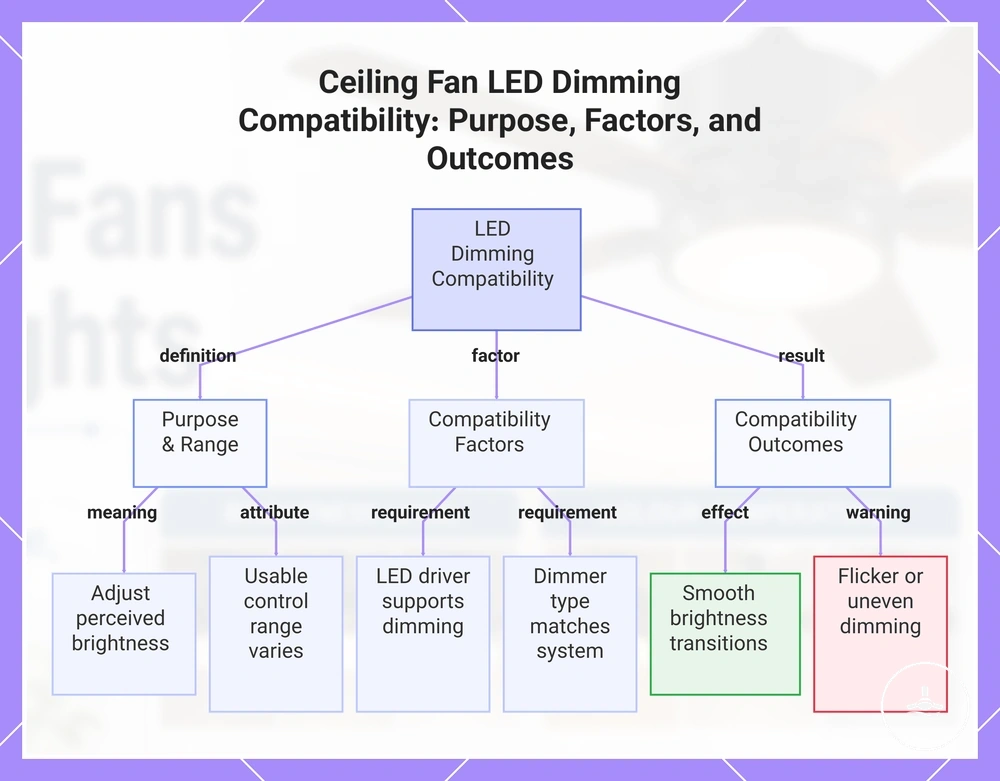
Dimming is a system-level compatibility relationship. Smooth control depends on a dimmable LED source or module, a compatible driver, and a compatible wall, remote or smart controller. Dimming reduces light output within the system's supported operating range; it does not increase the fixture's maximum lumen output.
- Confirm dimmability: verify that the LED module or lamp and driver are designed for dimming.
- Match the control method: use a dimmer or fan control intended to work with the lighting system rather than assuming any dimmer will be suitable.
- Check the usable range: minimum stable brightness can vary by driver and control combination.
- Watch for mismatch symptoms: flicker, stepping, delayed response, drop-out at low levels or an unusually narrow dimming range can indicate incompatibility or a control issue.
- Keep fan and light controls distinct: a control that changes fan speed is not automatically a compatible LED dimmer.
Compatibility rule: treat dimming as an end-to-end chain—LED source/module → driver → controller. If any link is not designed for the same control method, smooth dimming is not guaranteed.
For the main control types used with ceiling fans, see controls for dimming and fan speed.
Factors Influencing LED Brightness, Efficiency and Output Consistency in Ceiling Fans
Two ceiling fan lights can look similar yet behave differently because performance comes from the complete lighting system. The LED package, driver, thermal management, optical design and mechanical integration influence how much light is produced, how evenly it is distributed and how stable the output remains during operation.
| Factor | Attribute | Value / relationship | Practical consequence |
|---|---|---|---|
| LED driver | Power regulation | Supplies and regulates electrical power to the LED load. | A well-matched driver supports stable output and predictable control behaviour. |
| Thermal management | Heat control | Moves heat away from temperature-sensitive LED and driver components. | Lower operating stress can help slow heat-related lumen depreciation and component ageing. |
| Optical design | Light distribution | Diffuser and geometry shape the spread and uniformity of illumination. | The same lumen output can feel more or less useful depending on distribution. |
| System integration | Component coordination | LED, driver, controls, housing and cooling operate as one system. | Compatibility and thermal design influence efficiency, consistency and serviceability. |
Effective thermal management does not make every LED system identical, but it can reduce a major source of long-term performance stress. For the configuration trade-off behind these systems, see integrated LED versus light kit.
Common LED Ceiling Fan Light Issues: Not Bright Enough and Integrated LED Limitations
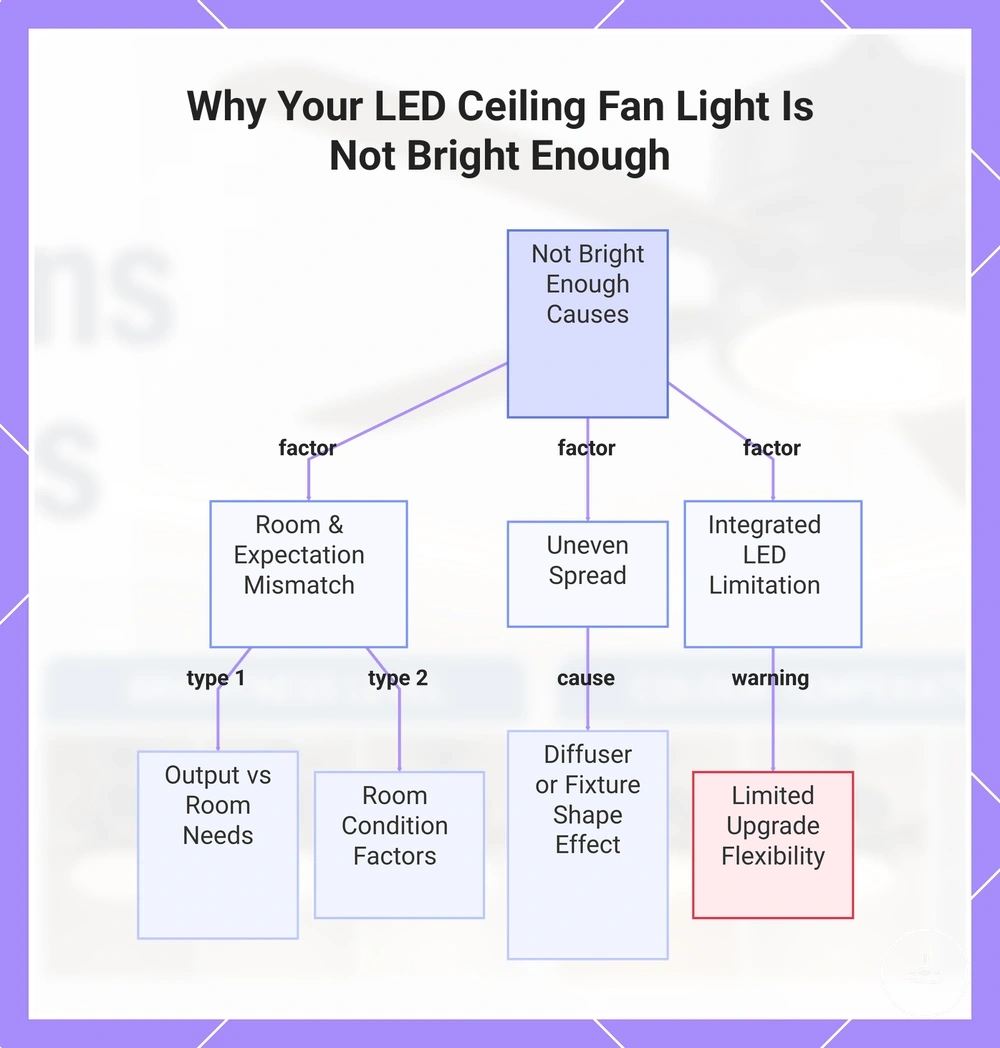
When an LED ceiling fan light is “not bright enough”, first separate insufficient lumen output from poor distribution, room-condition effects and control or component problems. An integrated LED design can also limit upgrade flexibility, but “integrated” does not automatically mean the light is impossible to service; the replaceable part may be the module, driver or, in some designs, the complete fixture.
| Observed issue | Likely relationship | What to check | Next decision |
|---|---|---|---|
| Always seemed too dim | Output or room-fit mismatch | Published lumens, room size, ceiling height, darker surfaces and other available lighting. | Choose more light output, improve distribution, or add supplementary lighting. |
| Bright near the fixture but weak across the room | Distribution / diffuser effect | Diffuser shape, obstruction and how light reaches the room edges. | Prioritise broader optical distribution rather than lumen rating alone. |
| Dim only at certain control settings | Dimming or controller compatibility | Driver dimmability, controller type and minimum stable dimming level. | Correct the control match before treating the LED module as underpowered. |
| Noticeably dimmer than it used to be | Lumen depreciation, heat stress or component ageing | Whether the change persists at full output under the same room conditions. | Inspect the serviceable LED module, driver and thermal condition; follow the model's service path if replacement is needed. |
| Integrated light cannot be upgraded like a bulb | Serviceability limitation | Whether the model has a replaceable module or driver. | Use the documented service part where available; otherwise the fixture design may determine the replacement scope. |
Use this diagnostic order before assuming a defect: output → distribution → room conditions → controls → component ageing. For the wider selection context, compare these limits with the main ceiling fans with lights guide.
Brightness and Performance Variability in Integrated LED Ceiling Fan Systems
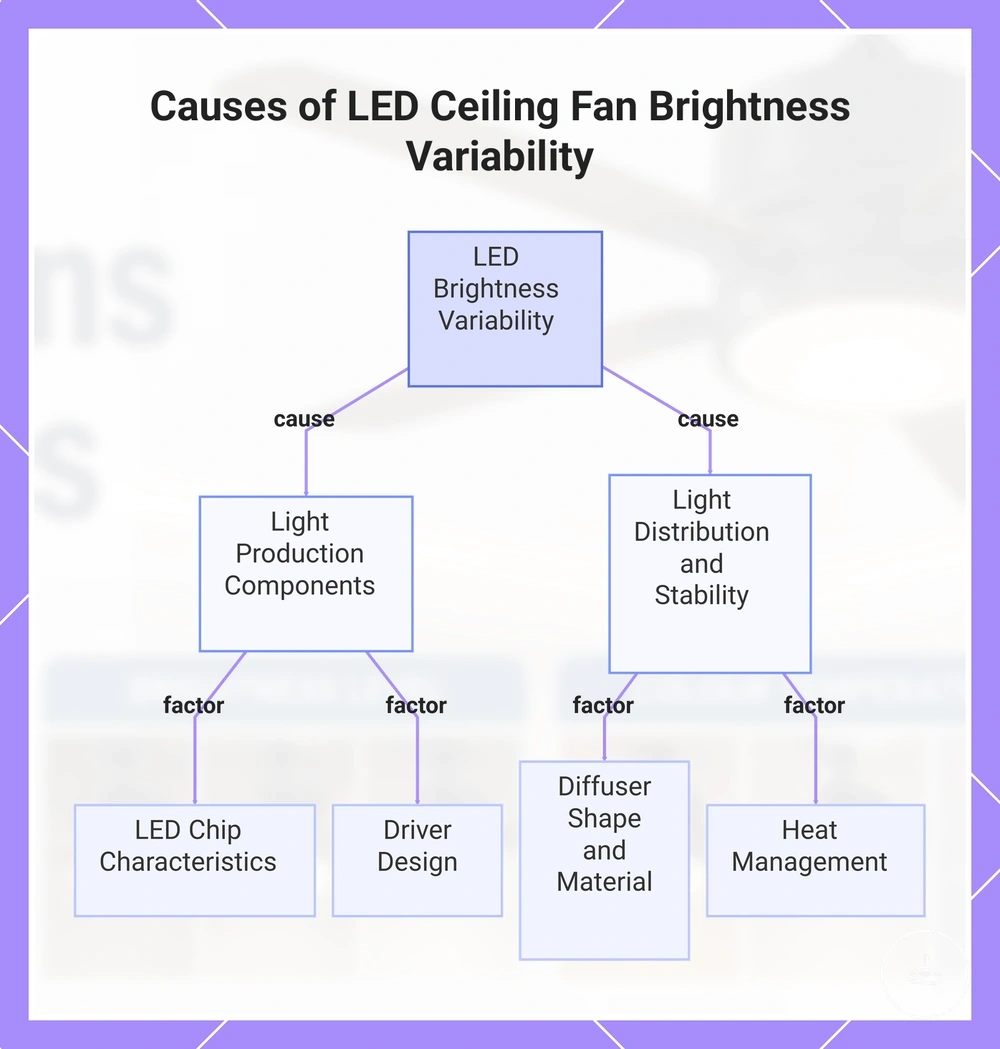
Integrated LED ceiling fan systems with similar external styling can still produce different results because internal components and thermal design determine output, regulation and distribution. Appearance therefore has low diagnostic value compared with the component relationships below.
LED package
Attribute: light generation and efficiency. Different LED packages can produce different output and spectral characteristics at the system's operating conditions.
Driver
Attribute: electrical regulation. Driver design affects output stability, dimming behaviour and how the LED is operated.
Diffuser / optics
Attribute: distribution. Shape, material and transmission affect how evenly available light reaches the room.
Thermal design
Attribute: heat control. Operating temperature influences component stress and long-term lumen maintenance.
Comparison rule: do not assume two integrated fans with the same size or visual style have the same lighting performance. Compare the published light output, CCT options, dimming support and serviceability where those specifications are available.
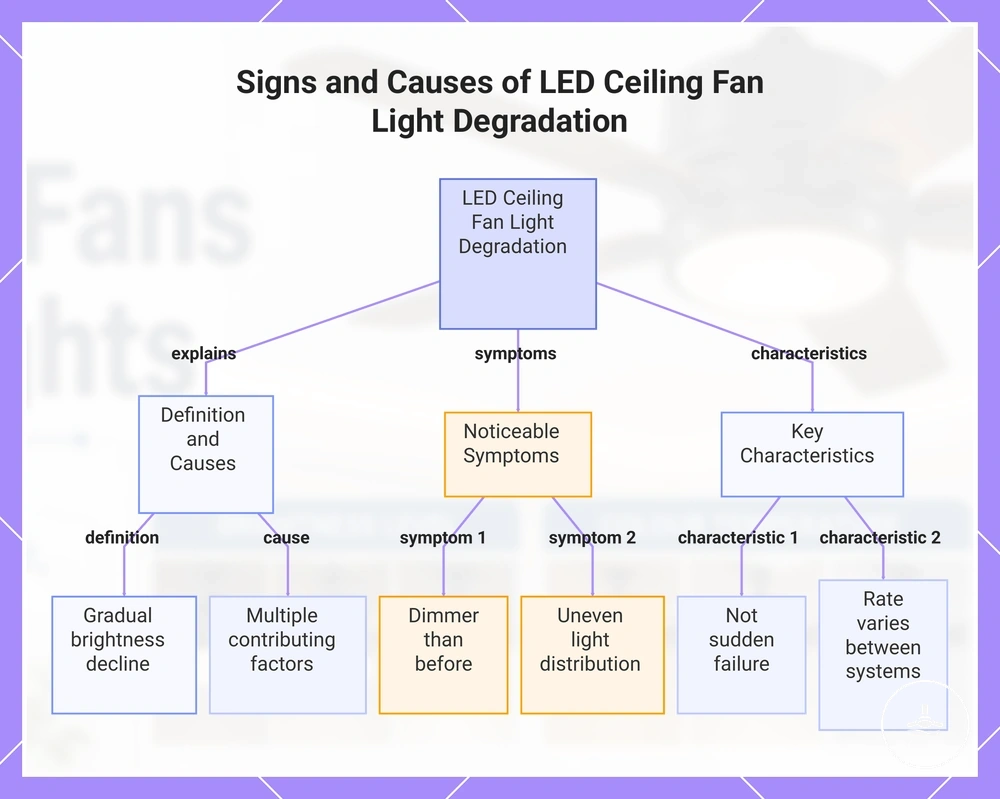
When LED Ceiling Fan Lights Require Replacement or Output Degradation Becomes Noticeable
LED output usually depreciates gradually rather than behaving like a simple on/off lifetime. A useful maintenance concept is lumen maintenance: for example, L70 means the light source is producing 70% of its initial luminous flux at the stated test conditions. The number of operating hours associated with that point is product-specific, so it should not be assumed from the LED category alone.
Do not replace on age alone. Compare performance under the same conditions: full-output setting, same room, same other light sources and a clean diffuser. A persistent decline, abnormal flicker, colour shift, intermittent operation or driver symptoms can justify inspection of the serviceable components.
| Observation | Interpretation | Practical response |
|---|---|---|
| The light is persistently dimmer at full output than it was under the same conditions. | Possible lumen depreciation, heat-related stress, driver change or another system issue. | Check the diffuser, control setting, driver and serviceable LED components before deciding on replacement. |
| Output becomes unstable, flickers or cuts out. | May indicate a control, connection, driver or LED-module problem rather than normal gradual depreciation. | Troubleshoot the control and electrical/service path appropriate to the fan model. |
| Light distribution looks less even. | Can come from optical contamination, diffuser changes or uneven component performance. | Inspect and clean accessible optical surfaces, then compare again at full output. |
| The integrated module is not user-replaceable. | Replacement scope is determined by the fan's service design. | Use the documented module/driver service option where available; otherwise a qualified service route or fixture replacement may be required. |
Normal LED ageing is gradual, but the rate is not universal. Thermal conditions, driver design, operating hours and component quality all affect how quickly a visible change appears, which is why a fixed replacement interval should not be assumed for every ceiling fan light.