
Ceiling Fans with Lights vs Without Lights
Choose a ceiling fan with a light when the room needs both airflow and useful illumination from the same ceiling position. Choose a ceiling fan without a light when existing ceiling, wall or lamp lighting already meets the room's needs and you prefer a cleaner fan profile or independent lighting control. If future lighting needs are uncertain, a fan that explicitly supports a compatible optional light kit can preserve flexibility.

Room-fit decision assistant
Use the room's current lighting first, then refine the choice by the role of the ceiling fixture and your preferred lighting control or visual profile. This assistant evaluates configuration fit; it does not rate product quality or guarantee model compatibility.
| Decision factor | Ceiling fan with light | Ceiling fan without light |
|---|---|---|
| Room lighting | Can provide central or supplementary illumination as well as airflow. | Requires separate lighting to meet the room's illumination needs. |
| Airflow | Light presence does not by itself determine airflow; compare the fan's airflow-related specifications. | Light absence does not by itself determine airflow; compare the same fan performance attributes. |
| Fixture profile | The light assembly can add depth and visual presence. | Usually keeps the ceiling fixture visually simpler. |
| Controls | Fan and light may be controlled separately or together, depending on wiring, receiver and model design. | Fan operation remains separate from the room's other lighting controls. |
| Future lighting flexibility | Depends on whether the light uses replaceable bulbs, a replaceable module or a model-specific integrated assembly. | Lighting changes remain independent of the fan unless the fan explicitly supports an optional compatible light kit. |
The decisive question is not whether one fan type is universally better; it is whether the room needs the fan position to solve a lighting requirement as well as an airflow requirement.
Compare the lighting plan before product features: airflow and lighting are separate attributes, so a built-in light does not automatically make a fan better or worse at moving air. After lighting fit, compare ceiling clearance and fixture depth, control method, maintenance access and future light-kit compatibility. For a broader overview, see the ceiling fans with lights guide.
What Changes When a Ceiling Fan Includes a Light
A ceiling fan with a light combines two functions at one ceiling position: air movement and illumination. The light changes the fixture's lighting role, control requirements, depth and maintenance path, but it does not by itself determine airflow performance.
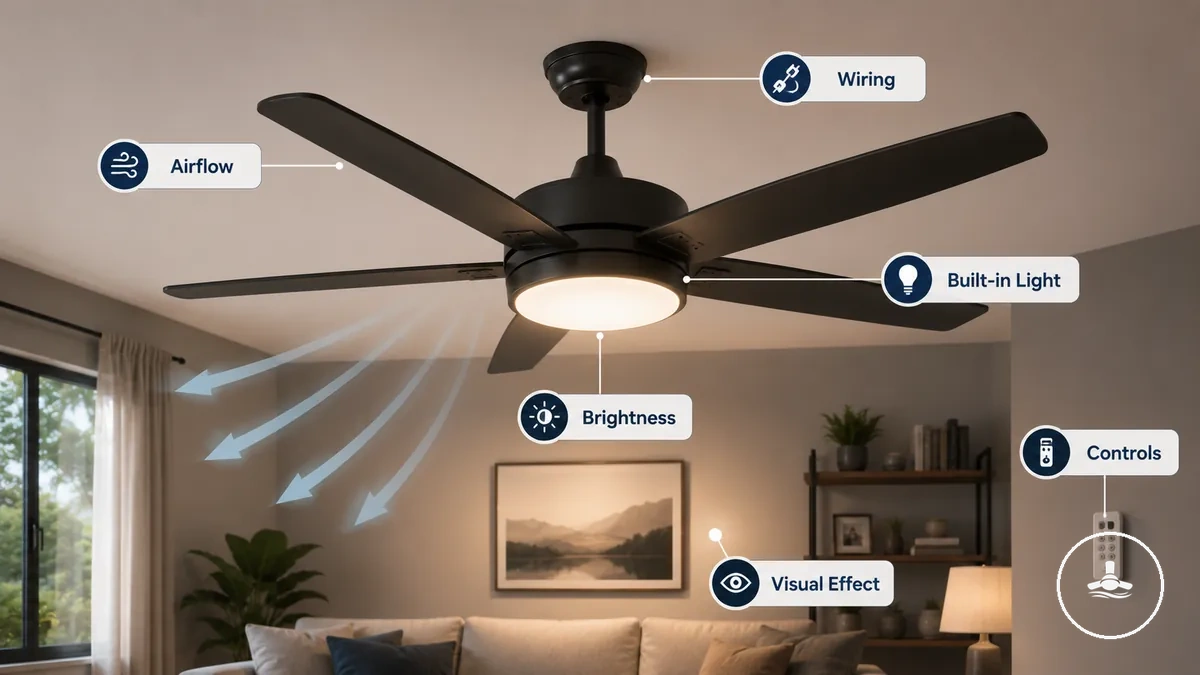
The practical change is that the fan can now contribute to the room's lighting plan. Brightness, beam spread, glare and dimming depend on the light design, while independent fan/light operation depends on the model's controls, receiver and available wiring. For the parts involved, see what ceiling fans with lights include.
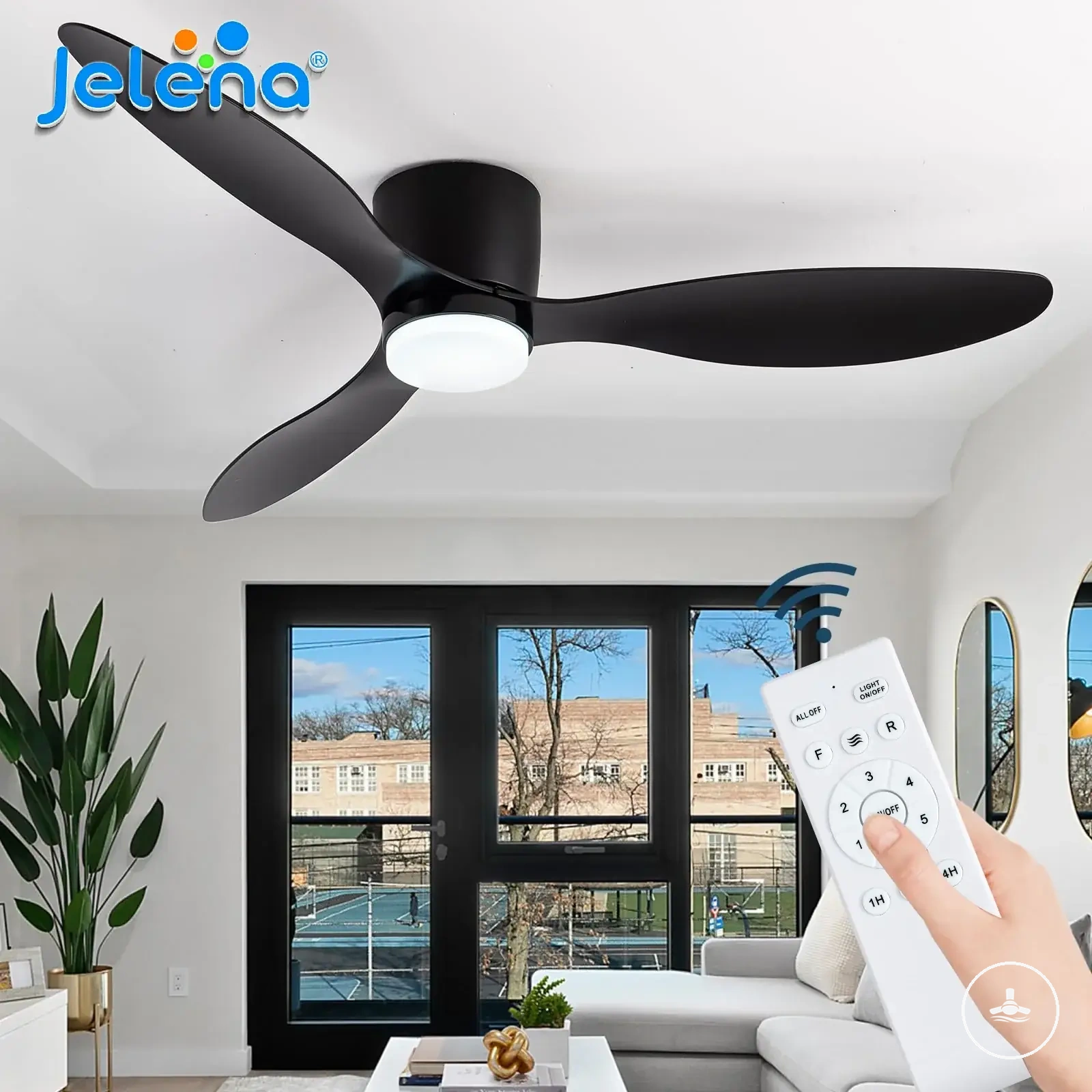
The image shows the added lighting element; the table separates the main entity → attribute → practical effect relationships.
| Attribute | Value or condition | Practical effect |
|---|---|---|
| Lighting function | Integrated illumination is added to the fan fixture. | May reduce the need for a separate central ceiling light when its output and distribution suit the room. |
| Fan/light control | May be separate or combined, depending on switches, receiver and model design. | Confirm that everyday fan and light control matches how the room will be used. |
| Replacement path | May use a replaceable bulb, replaceable LED module or model-specific integrated light assembly. | Maintenance can range from simple bulb replacement to sourcing a compatible module or assembly. |
| Fixture depth | The light assembly adds physical and visual depth below the fan body. | Low ceilings and prominent sightlines make depth and clearance more important. |
| Electrical compatibility | Control and connection requirements are model- and installation-specific. | Use the fan manufacturer's installation requirements and the existing electrical setup to confirm compatibility. |
Built-In Fan Lighting Compared with Separate Room Lighting
Built-in fan lighting places airflow and illumination at the same ceiling point, while separate room lighting lets ceiling lights, wall lights and lamps place light independently of the fan. The better arrangement depends on where light is needed, not simply on whether the fan can include a lamp.
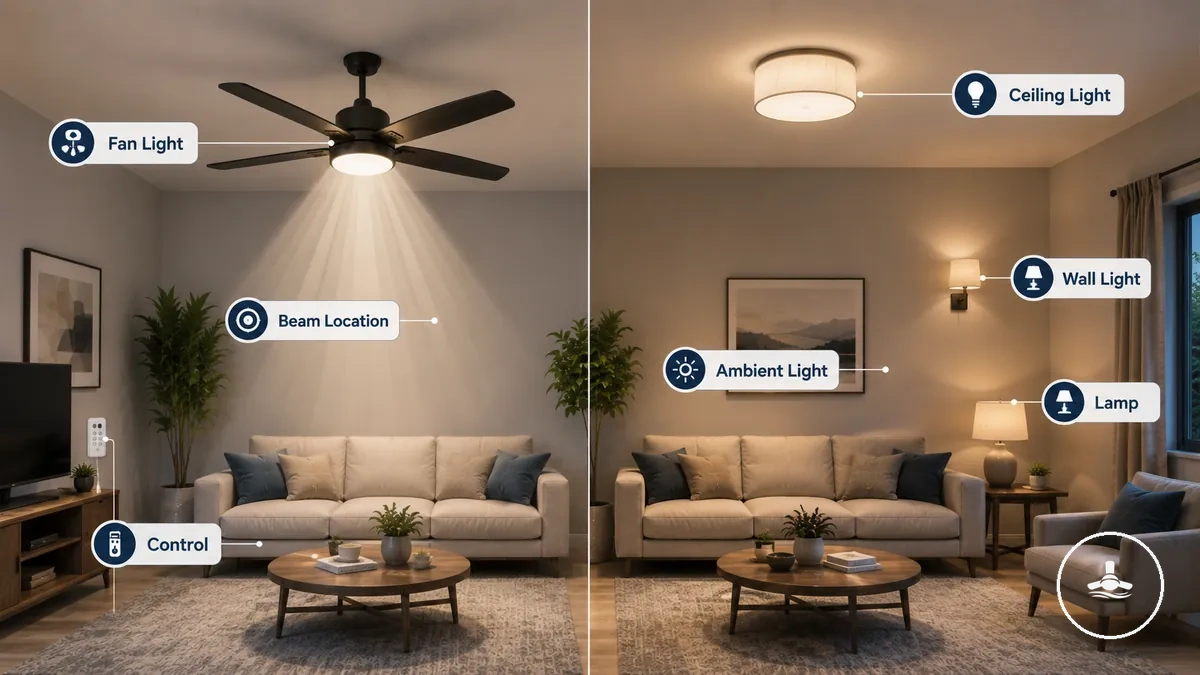
For rooms that need ambient and task lighting, compare light placement, beam spread, glare, dimming and control. A fan light can be convenient central illumination, while separate sources can put light closer to reading, work or seating areas. For more detail, see built-in lighting performance.
| Lighting option | Main strength | Main limitation | Best-fit condition |
|---|---|---|---|
| Built-in fan lighting | Combines central airflow and illumination in one ceiling fixture. | Light position and distribution are tied to the fan location. | Useful when the fan's ceiling position is also a suitable place for general lighting. |
| Separate ceiling light | Can be selected specifically for room illumination. | Needs its own ceiling position or lighting arrangement. | Useful when lighting and airflow should be specified independently. |
| Wall lighting | Can add ambient light without putting all illumination overhead. | Coverage depends on wall position and fixture direction. | Useful for layered lighting and visual balance. |
| Lamps / task lighting | Places light close to an activity or seating area. | Usually supplements rather than replaces whole-room lighting. | Useful where lighting needs change by activity or location. |
Ceiling Fans with Lights: Benefits and Trade-Offs
A ceiling fan with a light is strongest when one ceiling fixture needs to provide both airflow and useful illumination. Its trade-offs come from the same integration: the light adds visual depth, another control function and light-specific maintenance or replacement considerations.
Use the matrix below to evaluate the benefit together with the condition that can limit it.
| Attribute | Benefit | Trade-off or condition | Decision signal |
|---|---|---|---|
| Combined fixture | Uses one fan position for airflow and lighting. | The fan location also fixes the position of the central light. | Strong fit when that ceiling point is suitable for both functions. |
| Central illumination | Can provide or supplement general room lighting. | Brightness, colour temperature, beam spread and glare are model-specific. | Check the light output and distribution against the room's actual lighting need. |
| Control convenience | Fan and light functions can be available from the same fixture or controller. | Independent control depends on the fan's switch, remote, receiver or wiring arrangement. | Choose a control method that matches daily use rather than assuming all lighted fans behave the same way. |
| Ceiling-space efficiency | Can avoid needing a separate central ceiling light fixture. | The light assembly adds fixture depth and visual weight. | Useful where fixture positions are limited and the extra depth still suits the ceiling. |
| Maintenance | Keeps fan and central light in one fixture. | Light components may be bulb-based, module-based or integrated and model-specific. | Check how the light is replaced before choosing the fan. |
Ceiling Fans Without Lights: Benefits and Limits
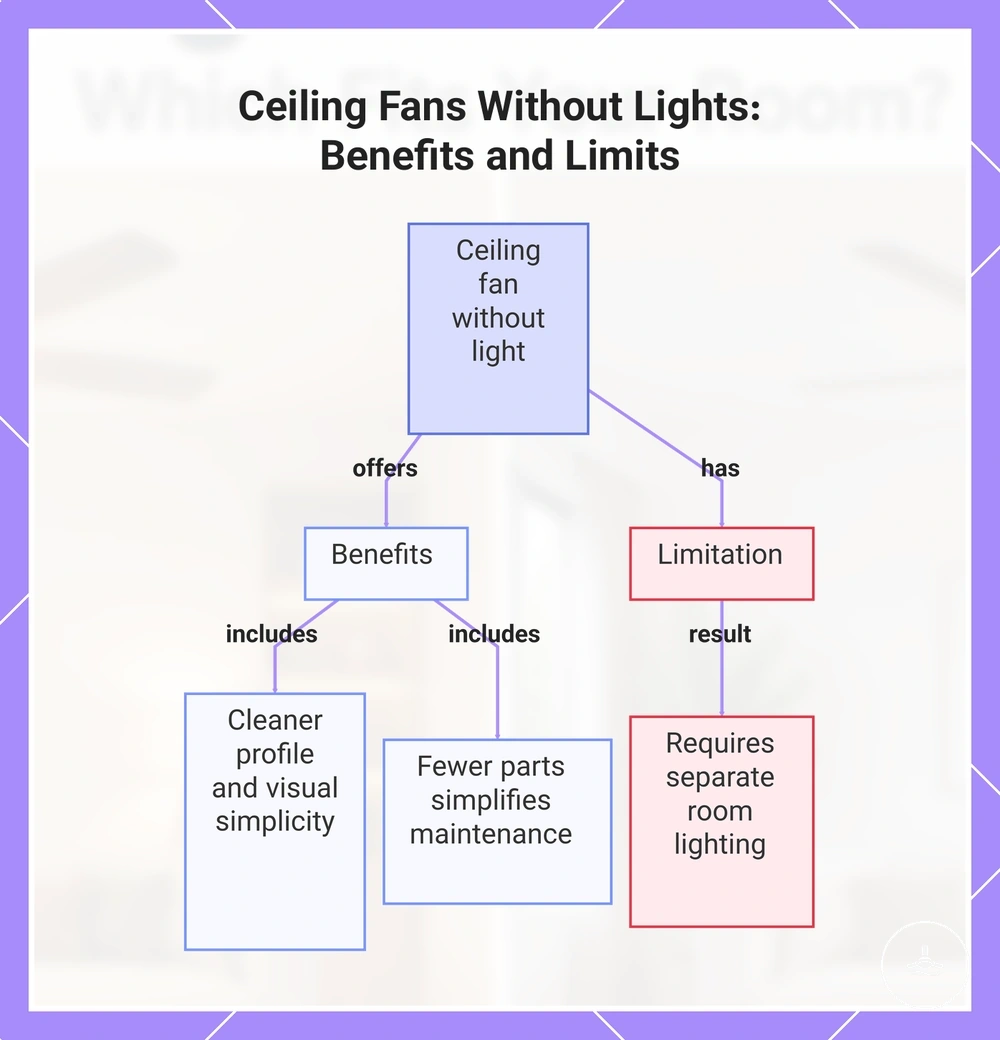
A ceiling fan without a light is a deliberate airflow-only fixture. It is a strong fit when separate lighting already meets the room's needs and the fan does not need to act as a central light source.
A no-light design usually has fewer light-related parts and a simpler profile, but it does not remove the room's lighting requirement: ceiling lights, wall lights or lamps must still provide suitable illumination. Light-related maintenance shifts to those separate fixtures rather than disappearing entirely.
- Existing lighting: separate lights already provide the required ambient and task lighting.
- Cleaner profile: the room benefits from less fixture depth or visual weight at the fan position.
- Independent control: fan operation and room lighting are intentionally controlled as separate systems.
- Glare management: overhead light from the fan position is unnecessary or undesirable for the layout.
- Maintenance boundary: there are fewer fan-light components to service, while separate lights retain their own maintenance needs.
The chart summarises those benefits while keeping the central limitation visible: a no-light fan still depends on another lighting plan.
Room Fit Criteria for Light and No-Light Fans
Room fit is determined by the lighting condition, ceiling position, available clearance, control preference and visual goal rather than by the room label alone. A bedroom or living room can suit either configuration when those attributes differ.
Use the criteria matrix to close the main room-fit decisions before comparing individual products or prices.
| Room condition | Decision value | What it favours | What to verify |
|---|---|---|---|
| Existing lighting | Separate lighting already meets daily room needs. | No-light fan becomes the baseline choice. | Check lighting after dark as well as during daylight hours. |
| Lighting gap at the fan position | The same ceiling point is expected to provide airflow and useful central illumination. | Lighted fan becomes the simpler combined-fixture choice. | Check brightness, glare, dimming and light distribution for the room. |
| Low ceiling / limited visual clearance | Extra light-kit depth is undesirable or may conflict with required clearances. | No-light or suitably low-profile configurations may fit better. | Follow the specific fan's installation clearances and applicable local requirements. |
| Daylight | Natural light can reduce daytime lighting demand but does not define night-time needs. | Either configuration; decide from the after-dark lighting plan. | Check how the room is used at the times artificial lighting is needed. |
| Future lighting uncertainty | The room may need fan-mounted lighting later. | An optional-light-kit-capable fan can preserve a future path. | Confirm that the exact fan model explicitly supports the intended compatible kit. |
Review these room-fit conditions alongside the features to compare before choosing, then compare individual models on the attributes that matter for the room.
Bedroom Fit
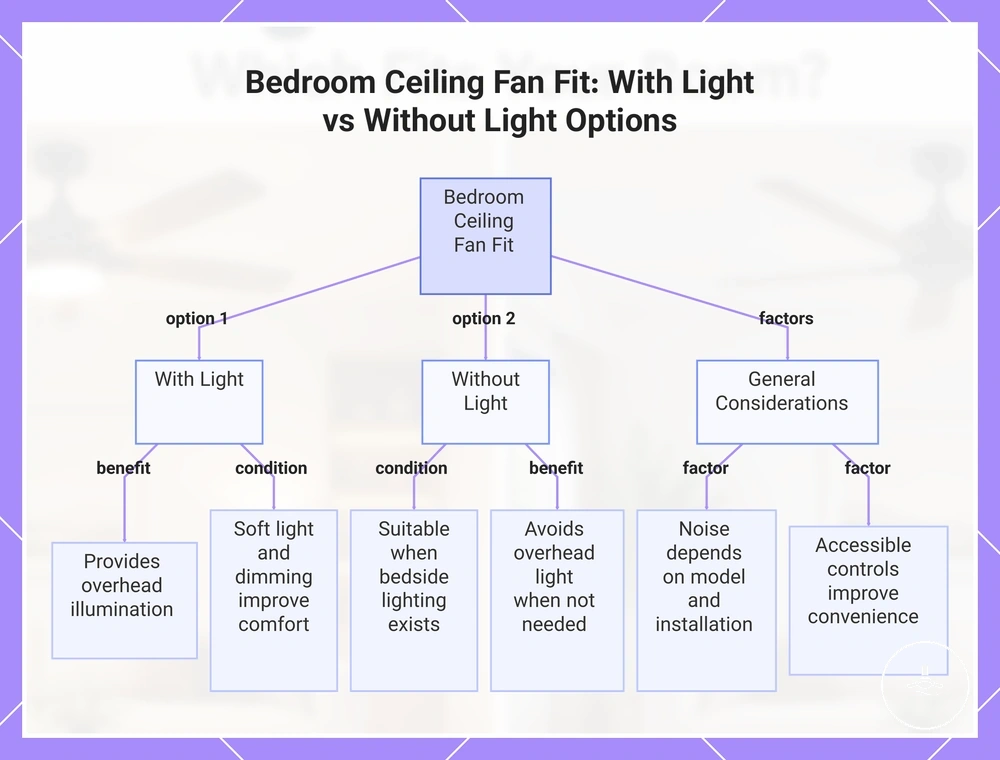
Bedroom fit depends on sleep comfort and night-time lighting behaviour. A fan light is useful when convenient overhead illumination is needed; a no-light fan is often a better fit when bedside or separate lighting already provides the required light.
- Night lighting: dimming can improve flexibility only when the selected fan light actually supports a useful dimming range.
- Glare: judge the light from bed height and normal sightlines, because diffuser design and brightness setting affect comfort.
- Separate bedside lighting: a no-light fan remains practical when lamps or other fixtures already cover reading and ambient needs.
- Noise: bedroom comfort depends on the fan model and installation quality; the presence of a light is not a reliable noise indicator.
- Controls: accessible fan and light controls can reduce night-time inconvenience, especially when functions can be adjusted without reaching a wall switch.
The chart compares the two bedroom configurations through comfort and lighting needs rather than treating either fan type as universally quieter or more suitable.
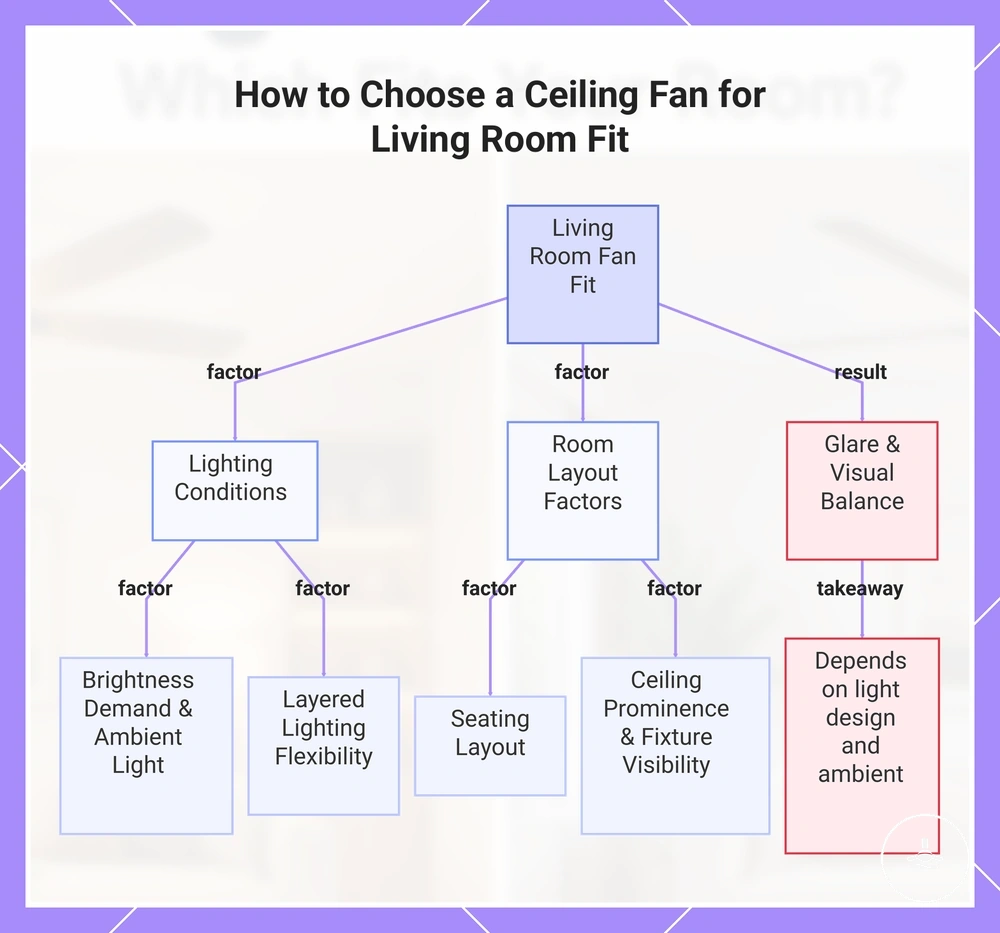
Living Room Fit
Living-room fit depends on how central lighting, layered lighting, seating and the fan's visual prominence work together. A fan light can add central illumination; a no-light fan can keep airflow separate from an existing layered lighting scheme.
- Layered lighting: wall lights, lamps and other sources provide more placement flexibility than relying on one central fan light alone.
- Central brightness: a fan light can contribute useful ambient light when its output and distribution match the room size and layout.
- Seating layout: place task or reading light where activities happen rather than assuming the fan position is ideal for every task.
- Ceiling prominence: an integrated light increases the fixture's visual presence and may become a stronger design element.
- Glare and balance: these depend on diffuser design, brightness, sightlines and surrounding light sources, not on the fan category alone.
The chart brings those lighting and layout conditions together for a living-room decision.
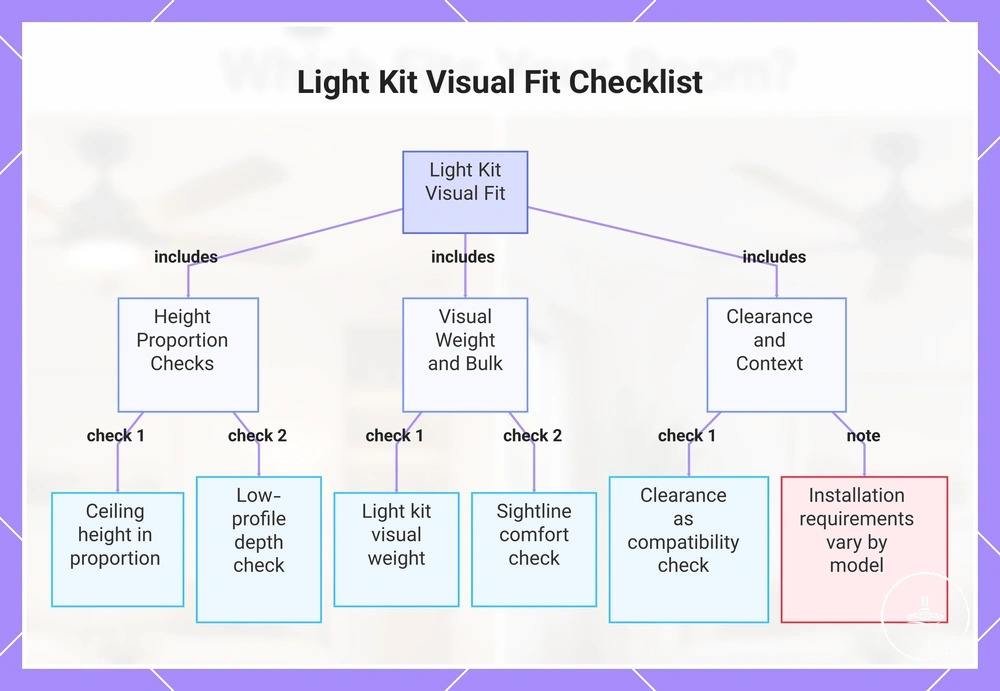
Ceiling Height and Visual Weight
Ceiling height and visual weight affect whether an added light assembly feels proportionate and whether the complete fan configuration fits the installation. Visual fit is not a substitute for required installation clearance: use the selected fan's installation instructions and applicable local requirements for the final clearance decision.
- Overall drop: compare the complete fan-and-light depth with the available vertical space, not the fan body alone.
- Low-profile need: if additional light-kit depth is undesirable, compare no-light or purpose-designed low-profile configurations.
- Sightlines: assess the fixture from seating areas and entrances because perceived bulk changes with viewing angle.
- Visual weight: integrated lights, diffusers and housings can make the fixture appear more prominent even when physical clearance is acceptable.
- Installation clearance: verify manufacturer-specified blade, floor and surrounding clearances for the exact model rather than using a visual estimate.
The chart is a visual-fit aid; final installation suitability remains model- and site-specific.
Light Kits, Integrated Lights, and Future Flexibility
Future flexibility depends on whether the fan has an integrated light, explicit optional light-kit support, a serviceable replacement light assembly, or no provision for fan-mounted lighting. These are different compatibility states, not interchangeable product labels.
A visually similar light kit is not proof of compatibility. Mounting interface, electrical connector, control electronics and replacement parts can be model-specific, so add-on or replacement lighting should be matched to the exact fan documentation. For a deeper comparison, see integrated lights and light kits.
| Configuration | Flexibility value | Main limitation | Decision signal |
|---|---|---|---|
| Integrated light | Lighting is part of the selected fan from the start. | Replacement or upgrade options may rely on model-specific components. | Choose when fan-mounted lighting is expected to remain part of the room plan. |
| Optional compatible light kit | Can preserve the ability to add fan-mounted lighting later. | The fan must explicitly support the exact compatible kit. | Useful when future lighting needs are uncertain. |
| Replaceable light assembly / module | May allow servicing without replacing the entire fan. | Replacement part availability and compatibility are model-specific. | Important when long-term serviceability is a priority. |
| No light-kit support | Keeps the fan permanently focused on airflow. | Fan-mounted lighting cannot simply be assumed to be addable later. | Suitable when separate room lighting is intended to remain independent. |
Cost, Energy Use, and Replacement Value
Total value includes more than purchase price. Compare the cost of the required fan configuration, installation or control changes, energy used by the functions you actually operate, and the likely replacement path for lighting components.
The lighting function adds energy use when the fan light is operating; models with electronic receivers or controls may also have a small standby load. A no-light fan shifts room illumination to separate fixtures, whose energy use still belongs to the room's total lighting use. Compare whole-room use rather than treating the fan fixture alone as the complete energy picture.
Replacement value also differs by design. A standard replaceable bulb, a replaceable LED module and a model-specific integrated light assembly have different service paths, while a no-light fan keeps lighting replacement independent of the fan.
The table compares stable value relationships without inventing current prices, installation charges or marketplace conditions. For broader context, see cost and value factors.
| Value factor | Lighted fan | No-light fan | Decision rule |
|---|---|---|---|
| Purchase configuration | Includes a lighting function and its associated hardware. | Omits fan-mounted lighting hardware. | Pay for the configuration the room actually needs rather than assuming the simpler or more feature-rich option is automatically better value. |
| Energy use | Fan operation plus lighting use when illuminated; electronic controls may also have a small standby load. | Fan motor use at the fan; room-lighting energy is consumed by separate fixtures. | Compare expected whole-room operation and actual light-use patterns. |
| Replacement access | Depends on whether the light uses a bulb, module or integrated assembly. | Fan and lighting replacement remain separate. | Prefer the maintenance path you can realistically service and source parts for. |
| Control compatibility | Fan and light controls may need coordinated switching, receiver or remote support. | Fan control can remain independent of existing room-light controls. | Check the intended control arrangement before purchase or installation. |
| Installation context | May require the existing ceiling point and controls to support both functions. | Still requires a suitable fan installation while lighting is handled elsewhere. | Assess the complete room and electrical configuration rather than the fan label alone. |
Paying for an included light is most defensible when the same ceiling point is expected to provide both airflow and useful illumination. If separate lighting already performs that job well, a no-light fan can avoid paying for a lighting function that the room does not need.
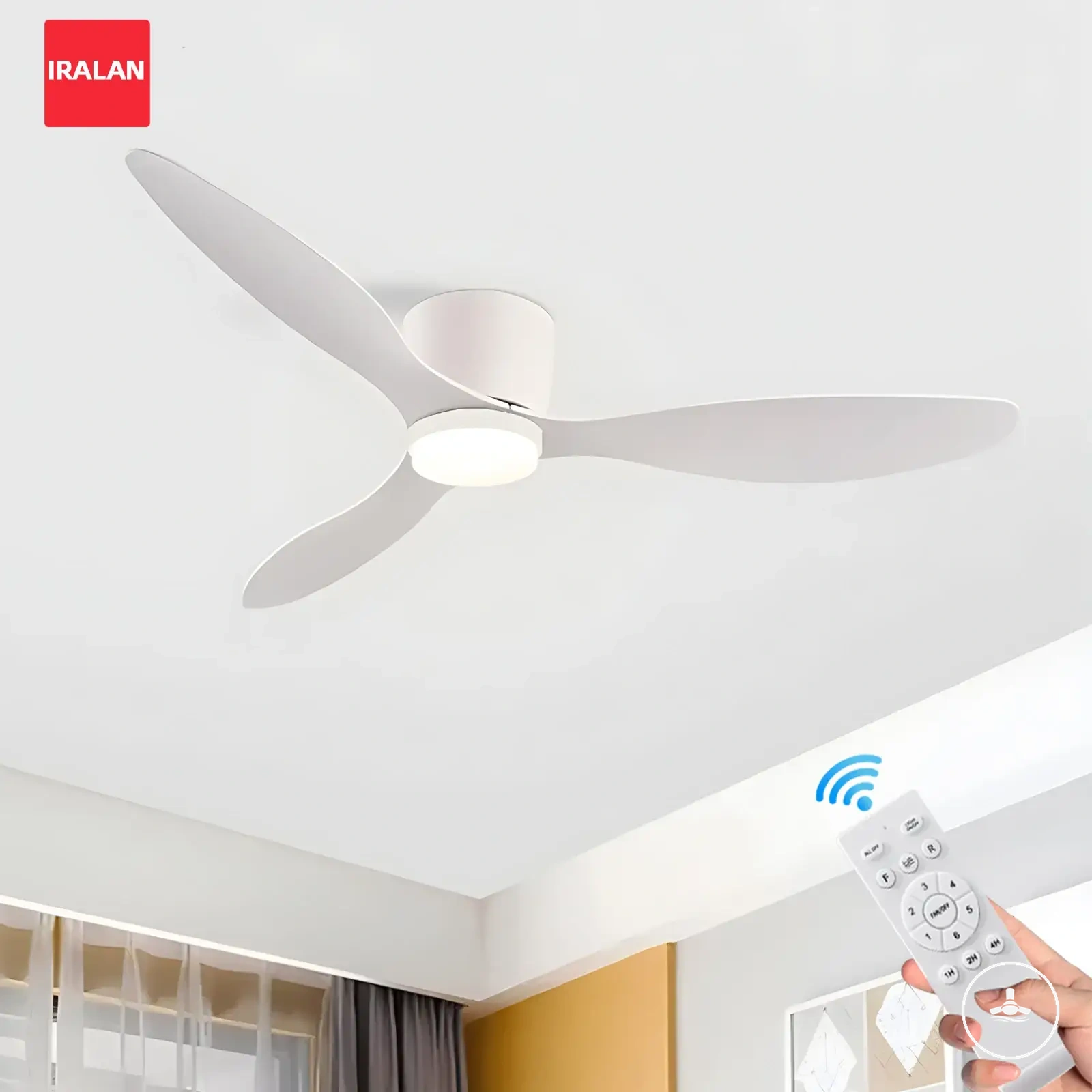
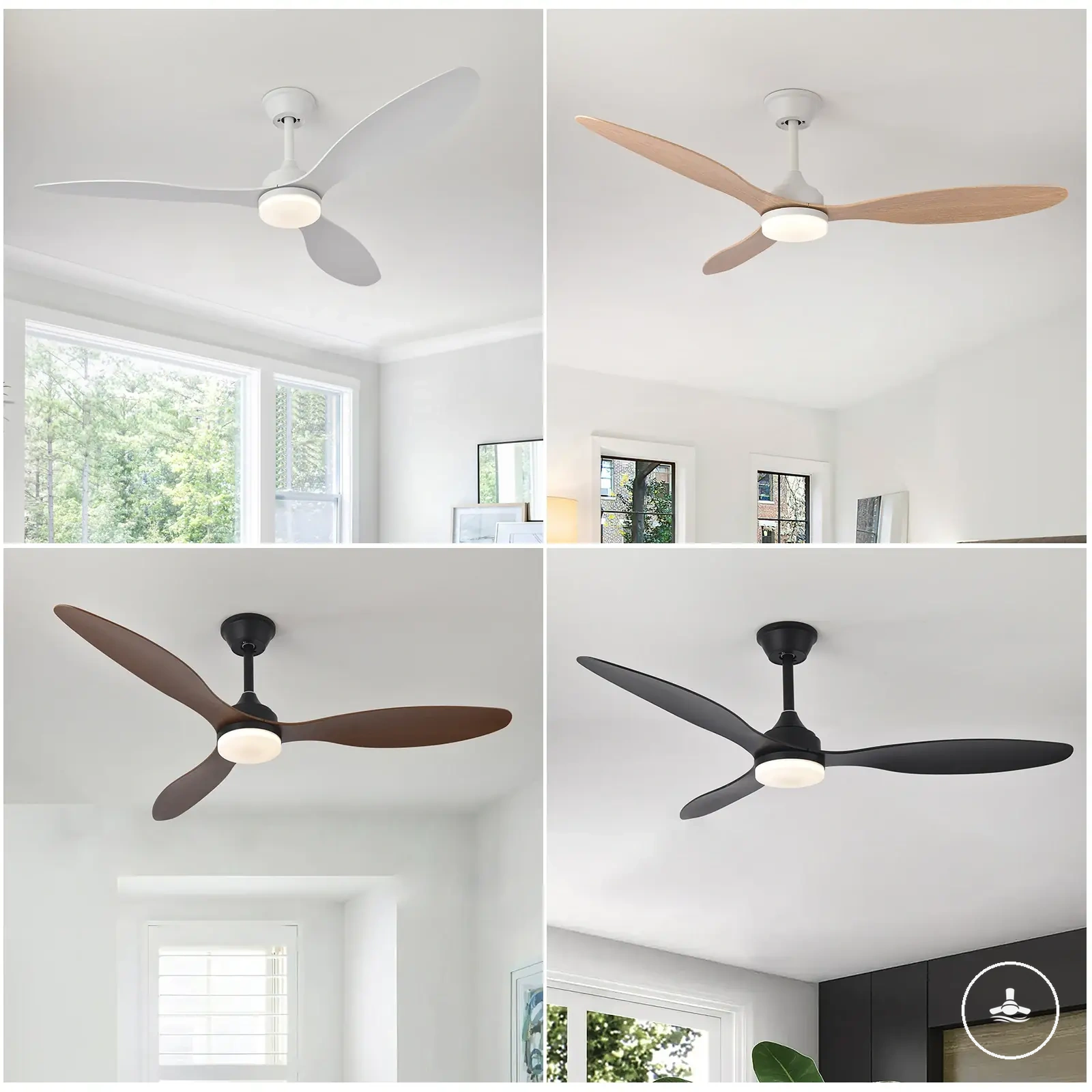
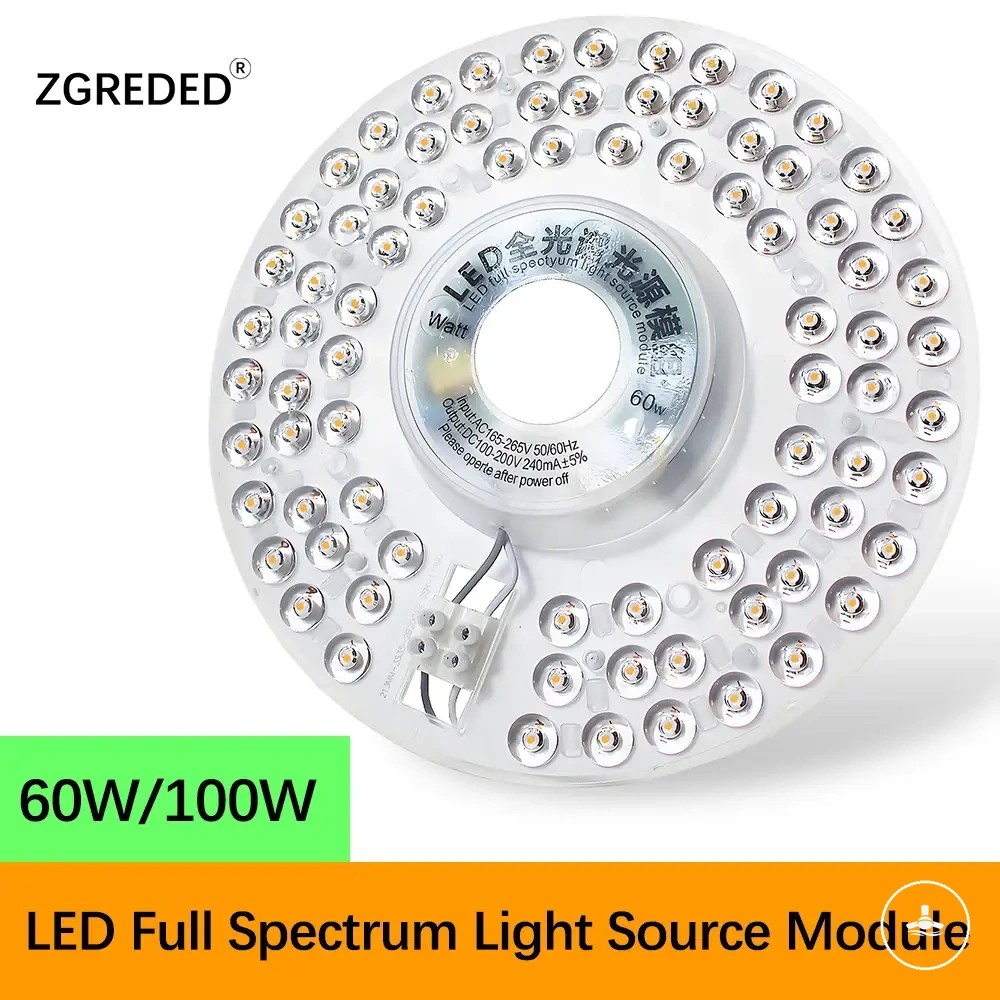
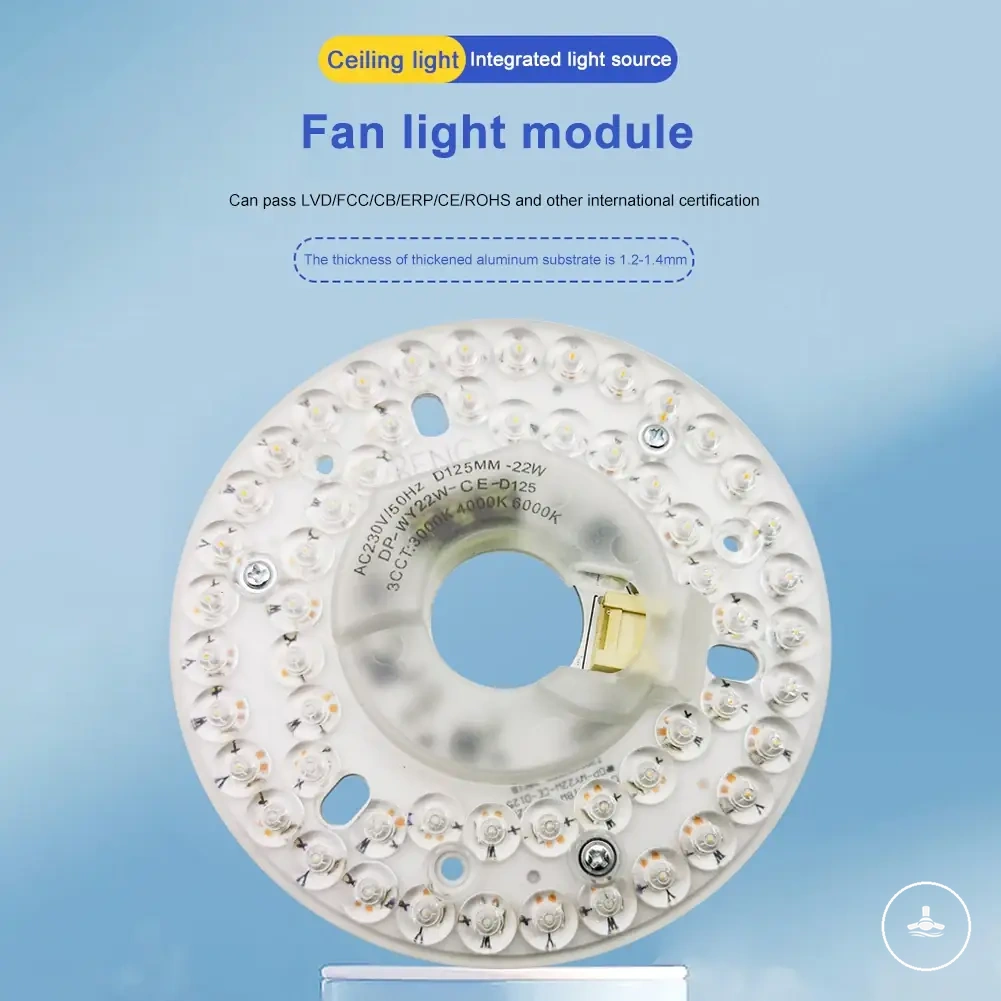
The existing examples below are lighted-fan and fan-light-kit listings, so use them to compare feature types after deciding whether a lighted configuration fits your room. They are not a complete lighted-versus-no-light product comparison. Verify current product details and compatibility on the destination page before purchase.
When Each Ceiling Fan Type Makes More Sense
The practical selection rule is: choose a fan with a light when the fan position must solve a lighting gap; choose a fan without a light when separate lighting already solves the room's lighting need. Then refine the choice by fixture depth, control preference, maintenance path and future flexibility.
The decision matrix turns those conditions into a final check without relying on price, brand or marketplace popularity.
| Choose a fan with a light when | Choose a fan without a light when | Check before deciding |
|---|---|---|
| The room has a lighting gap that the fan position should help solve. | Separate lighting already meets the room's needs. | Confirm whether the fan is expected to provide useful illumination. |
| One ceiling position should provide both airflow and central light. | The fan can be dedicated to airflow while lighting remains elsewhere. | Check ceiling position, room use and light placement together. |
| Built-in fan/light control is convenient for daily use. | Independent fan and lighting control is preferred. | Confirm how the exact model separates or combines its controls. |
| The added light depth and visual presence suit the ceiling. | A simpler or lower-visual-weight fan profile is preferred. | Compare complete fixture depth and required installation clearances. |
| The expected light maintenance path is acceptable. | Keeping lighting service independent of the fan is preferred. | Check bulb, module, integrated assembly or optional-kit serviceability. |
Borderline case: if lighting needs may change, an optional light-kit-capable fan can preserve flexibility, but only when the exact fan model explicitly supports the intended kit. Treat compatibility as a model-specific requirement, not as an assumption.
Choose a Ceiling Fan with a Light
Choose a ceiling fan with a light when airflow and illumination genuinely need to come from the same fixture. The light should solve a defined room requirement, not simply add another feature.
- Lighting gap: the room lacks suitable central illumination and the fan position is an appropriate place to add it.
- Single ceiling position: one fixture is expected to handle airflow and general lighting.
- Control fit: the model's fan/light controls support the way the room will be used.
- Visual fit: the extra light assembly depth and prominence suit the ceiling and sightlines.
- Maintenance fit: the bulb, module or integrated light replacement path is acceptable for long-term use.
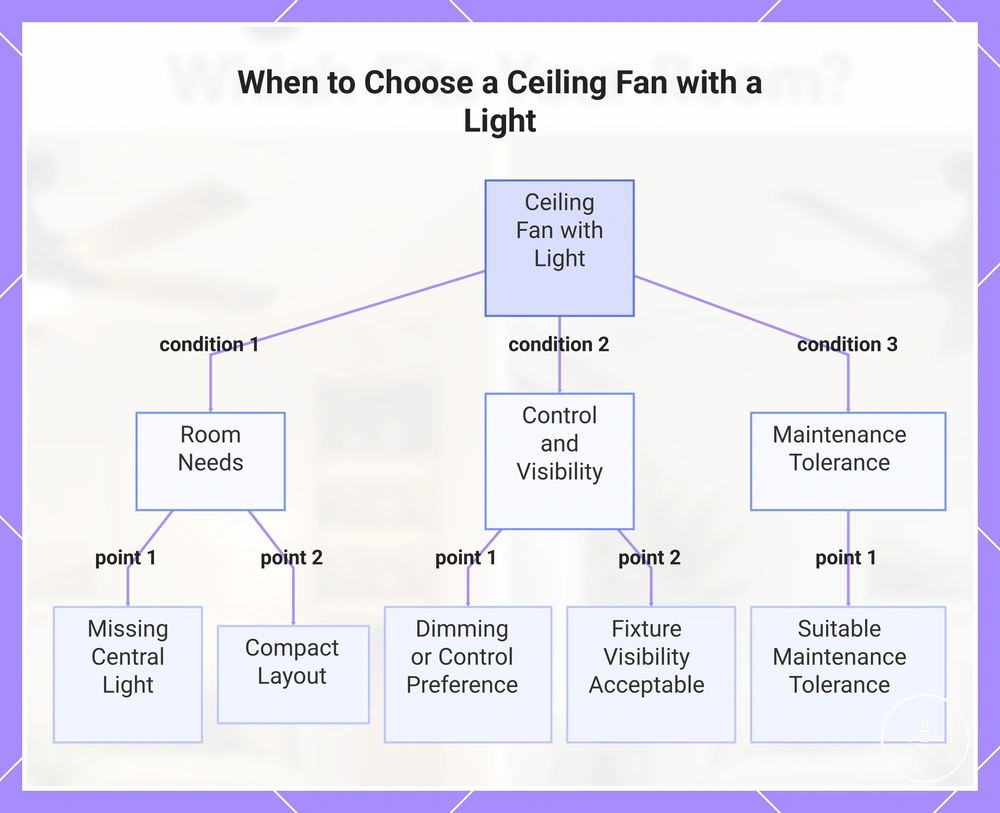
The chart summarises the conditions that make a combined fan-and-light fixture a strong room fit.
Choose a Ceiling Fan Without a Light
Choose a ceiling fan without a light when airflow is the fan's only required function and existing separate lighting already covers the room. This configuration is strongest when lighting control and maintenance are intentionally kept independent of the fan.
- Existing layered lighting: ceiling lights, wall lights or lamps already provide the required ambient and task illumination.
- Cleaner ceiling profile: additional fan-light depth or visual weight is unnecessary.
- Separate control: fan operation and room lighting are better managed independently.
- Lighting placement: the fan position is not the best location for the room's useful light.
- Maintenance boundary: fewer fan-light components are preferred, while separate lighting remains available and serviceable.
A no-light fan is not automatically the lower-energy or lower-cost room solution; those outcomes depend on the specific fan and on the separate lighting the room still uses.