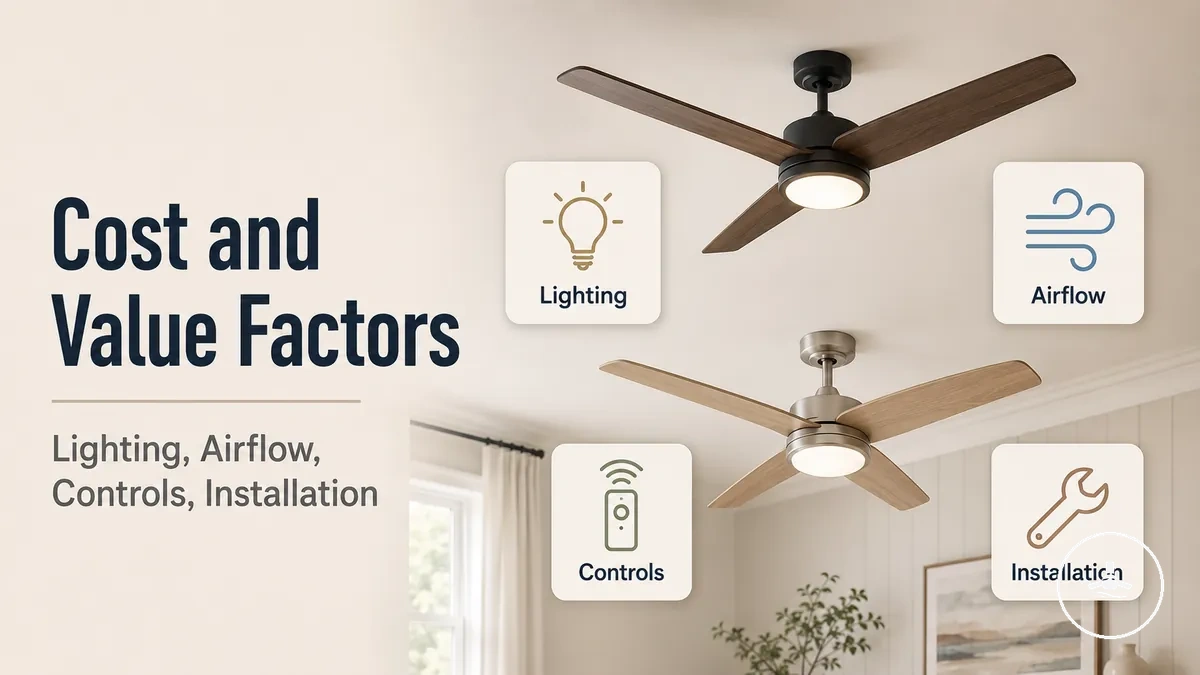
Ceiling Fans with Lights Cost and Value Factors: Pricing, Installation, Efficiency, and Feature Trade-offs
Choose among Ceiling fans with lights by comparing total installed cost with the airflow, lighting, controls, efficiency, and serviceability you will actually use. The best value is the option that fits the room, installation conditions, and usage pattern; paying more only adds value when the extra performance or convenience matters in that room.
Ceiling fan value decision assistant
Choose the conditions that describe your use. The result identifies which value factors deserve the most attention; it does not assume a live price, seller offer, or universal “best” model.
Select all five conditions, then evaluate the comparison priorities.
Use the result as a comparison filter: first confirm room and installation fit, then compare the motor, LED system, controls, and serviceability that affect your actual use.
The sections below separate purchase tier, installation impact, operating cost, feature depth, and maintenance so those factors can be compared without treating upfront price as the only measure of value.
Understanding Cost vs Value in Ceiling Fans with Lights as a Decision Framework
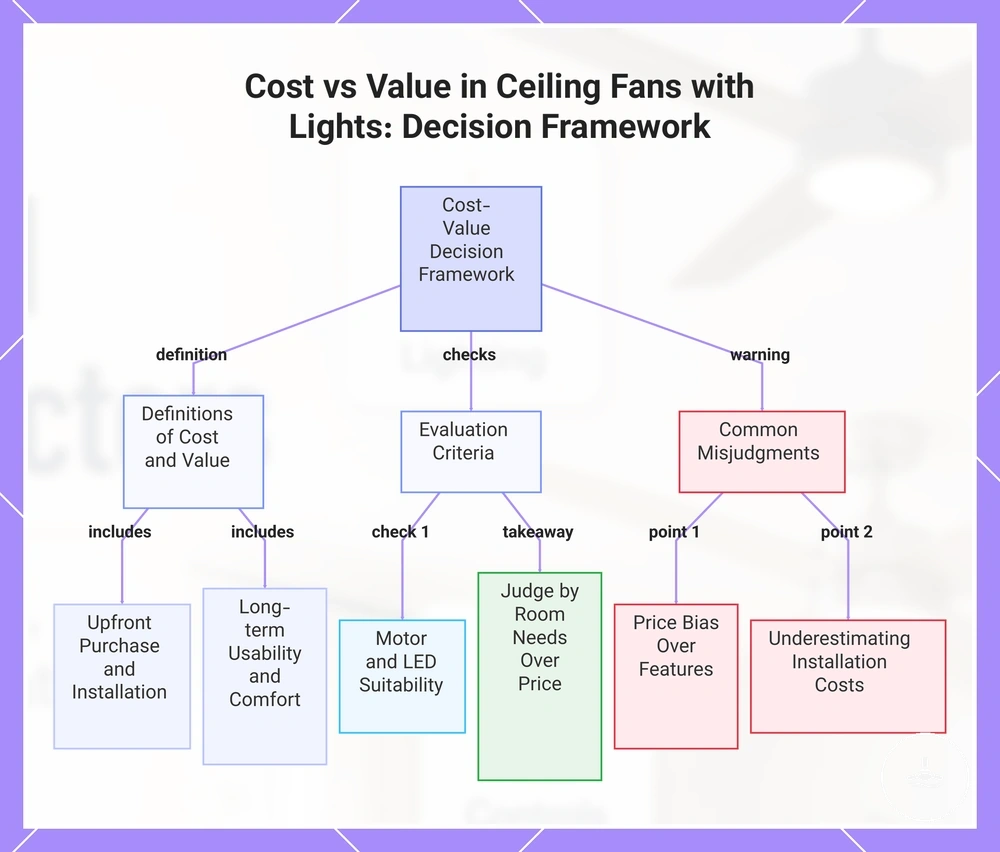
Cost and value in ceiling fans with lights answer different questions. Cost describes what is paid to obtain and install the fan; value describes how well the installed fan delivers the airflow, lighting, control, efficiency, and durability required for the intended room.
Cost
Purchase price plus installation-related work such as wiring, fan-suitable ceiling support, and mounting preparation.
Value
Usable airflow, suitable LED lighting, convenient controls, efficient operation, and dependable performance under the expected usage pattern.
A lower initial cost can still produce limited value when the motor, lighting, controls, or build quality do not suit the room. Conversely, a higher-priced fan can be poor value when its extra features are rarely used. The practical boundary is therefore installed cost versus useful performance over time, not price alone.
The decision framework is most reliable when the same criteria are checked in the same order. A buying checklist helps keep room needs, installation demands, lighting quality, and control expectations in one path.
- Confirm fit: match airflow and lighting needs to the room and expected use.
- Confirm installation: identify wiring, ceiling-support, and mounting work that can change total installed cost.
- Compare operating value: give more weight to motor and LED efficiency when the fan and light will run frequently.
- Pay for useful features: choose remote, smart, dimming, or serviceability features only when they solve a real use requirement.
Decorative finish or a higher price tier should not displace those functional criteria. The strongest value decision is the option that continues to fit the room after installation and repeated use.
This chart compares upfront cost and long-term value, including the criteria and common misjudgments that shape the decision.
Ceiling Fan with Light Price Range Breakdown Across Budget, Mid-Range, and Premium Options
Budget, mid-range, and premium are best treated as relative product tiers rather than fixed Australian-dollar bands. Actual prices vary with brand, size, motor design, lighting system, controls, finish, retailer, and installation requirements, so a fixed numerical range would not reliably describe every model.
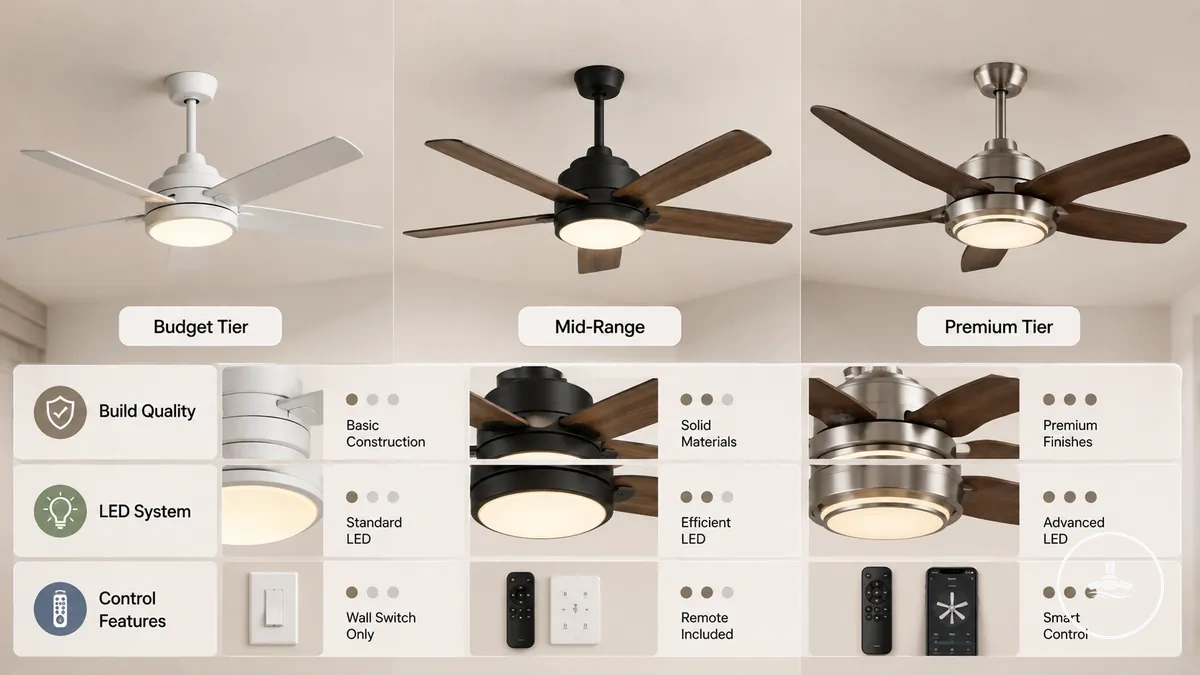
The tiers are still useful because they group the level of construction and feature integration a buyer is likely to compare. The table keeps the same attributes across all three tiers and adds the condition under which each tier is most likely to make sense.
| Tier | Relative cost position | Typical characteristics | Best-fit condition |
|---|---|---|---|
| Budget | Lower relative purchase cost | Essential airflow, basic LED lighting, straightforward controls, simpler construction | Best considered when room needs are simple and advanced controls or lighting adjustments are unlikely to be used |
| Mid-range | Middle relative purchase cost | Broader motor, LED, finish, and remote-control choices; often a balance between feature depth and cost | Useful when regular use justifies better efficiency or convenience without requiring the broadest feature set |
| Premium | Higher relative purchase cost | More refined construction, motor and lighting options, finishes, and advanced control integration | Worth considering when frequent use or specific comfort, control, finish, or serviceability requirements make those added attributes useful |
A higher tier is not automatically better value. Compare the features you will use against the room requirement and total installed cost; a structured buying checklist can keep that comparison consistent.
Key Price Drivers That Influence Ceiling Fans with Lights: Motor Type, Lighting, Size, and Controls
The main component-level cost drivers are motor design, LED lighting, fan size, and controls. They can change both purchase cost and usefulness, so two visually similar ceiling fans with lights can have different value profiles even when they sit in the same broad price tier.
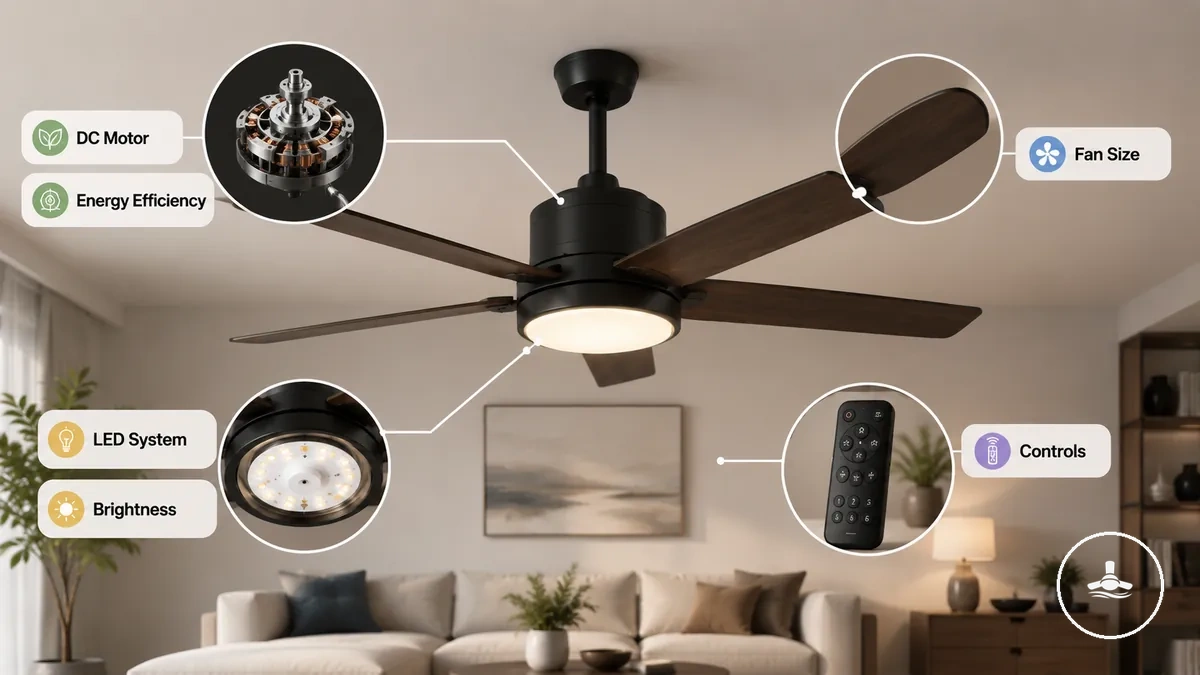
A DC motor often costs more to integrate than a basic motor-and-control system, but it can support lower electrical consumption, more speed control, and quieter operation depending on the fan design. The LED system affects brightness, dimming capability, colour/lighting quality, replaceability, and control complexity. For a deeper lighting comparison, see LED light value factors.
Fan size changes the physical design and suitability of the fan rather than acting as a simple “bigger equals better” value signal. Remote or smart controls add convenience and electronics; they are most valuable when speed and light settings are adjusted often. For control options, see control feature value.
| Cost driver | Attribute or state | Likely cost direction | Value implication |
|---|---|---|---|
| Motor | DC motor and more sophisticated speed control | Often increases upfront product cost | Can add value for frequent use through efficiency, speed range, and operating comfort |
| LED system | Dimming, brightness control, light quality, and serviceability | More capable systems can increase component complexity and cost | Adds value when lighting quality or adjustment is used regularly |
| Fan size | Blade span and associated construction | May affect material and motor requirements; effect varies by model | Value depends on matching the fan to the room rather than choosing the largest span |
| Controls | Remote or smart control functions | Usually adds electronics and feature cost | Adds value when convenient speed/light control is a frequent user need |
Are Ceiling Fans with Lights Worth It? Cost vs Benefit Analysis for Different Room Needs
Ceiling fans with lights are most likely to be worth it when the same room genuinely benefits from both air circulation and ceiling lighting. The benefit rises when the fan, light, or controls are used often enough for comfort and convenience to matter; extra features add little value when they are rarely used.
Bedroom and living-room needs are not identical. Bedrooms often place more weight on comfortable repeated use, controllability, and lighting flexibility, while shared living spaces may place more weight on adaptable airflow, lighting, and easy control for changing occupancy.
| Room context | Primary value focus | Features that may matter more | When extra spend is easier to justify |
|---|---|---|---|
| Bedroom | Comfort during regular use plus suitable task/ambient lighting | Quiet operation, useful speed control, dimming or brightness adjustment, convenient controls | When the fan or light is used frequently and those controls reduce disturbance or improve comfort |
| Living room | Airflow and lighting that adapt to shared activities and changing occupancy | Appropriate airflow, flexible lighting, accessible remote or smart controls | When the space is used often and multiple settings are genuinely useful |
The decision is therefore room-specific rather than tier-specific. Higher usage intensity can increase the importance of efficiency and flexible controls, while occasional use can make a simpler configuration better value. A buying checklist helps compare those needs before price becomes the deciding factor.
Installation Cost Impact and Electrical Requirements for Ceiling Fans with Lights
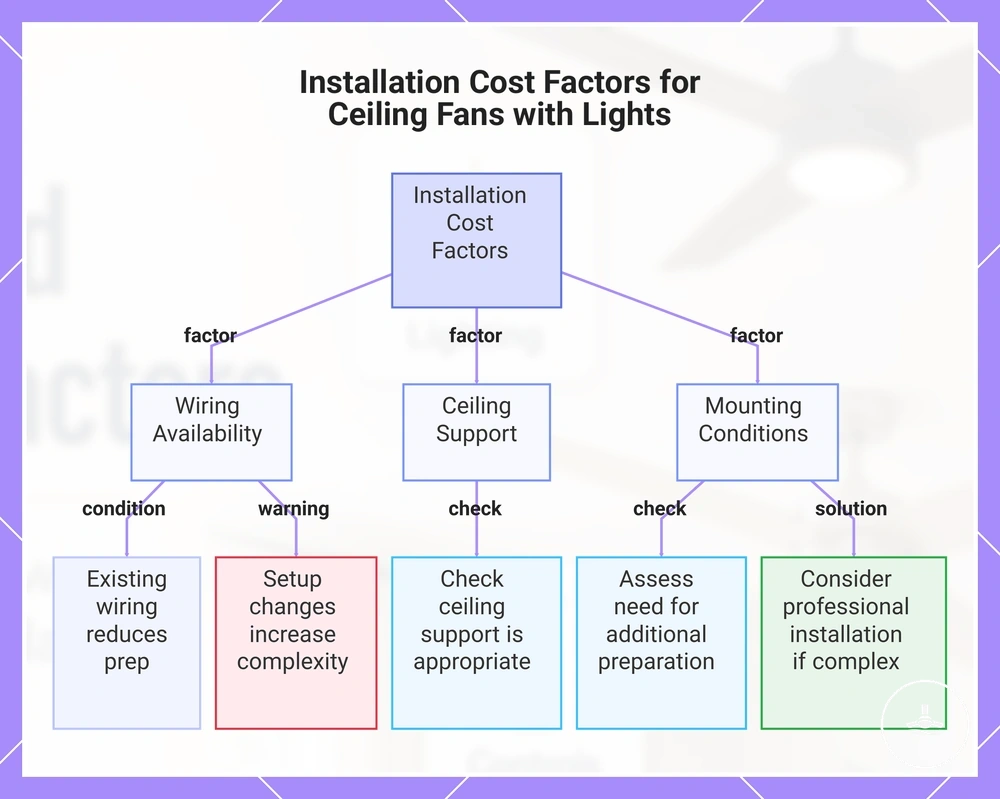
Installation can materially change total ownership cost because the fan depends on the condition of the existing wiring, ceiling support, and mounting position. A location that is already suitable can require less preparation; a location needing electrical or structural work can make a low purchase price less meaningful.
Do not assume a ceiling point intended only for a light fitting is suitable for a rotating ceiling fan. The mounting and support system must be appropriate for the selected fan and its installation requirements. Electrical work must also comply with applicable local requirements, so use a suitably qualified professional when the work or local rules require one.
Installation readiness checklist
- Confirm whether suitable wiring is available at the intended installation location.
- Check that the ceiling support and fixing method are appropriate for the selected ceiling fan with light.
- Assess ceiling height, mounting position, access, and any preparation that could add labour or hardware.
- Identify whether separate fan/light control, new wiring, or other electrical changes are required.
- Resolve uncertain structural or electrical conditions before using product price as the main comparison.
These checks affect installation cost and feasibility, not the fan’s advertised feature list. For more detail, see installation cost considerations.
This chart shows the main installation-cost factors, including wiring, ceiling support, and mounting conditions.
Energy Efficiency and Long-Term Operating Costs of Ceiling Fans with Lights
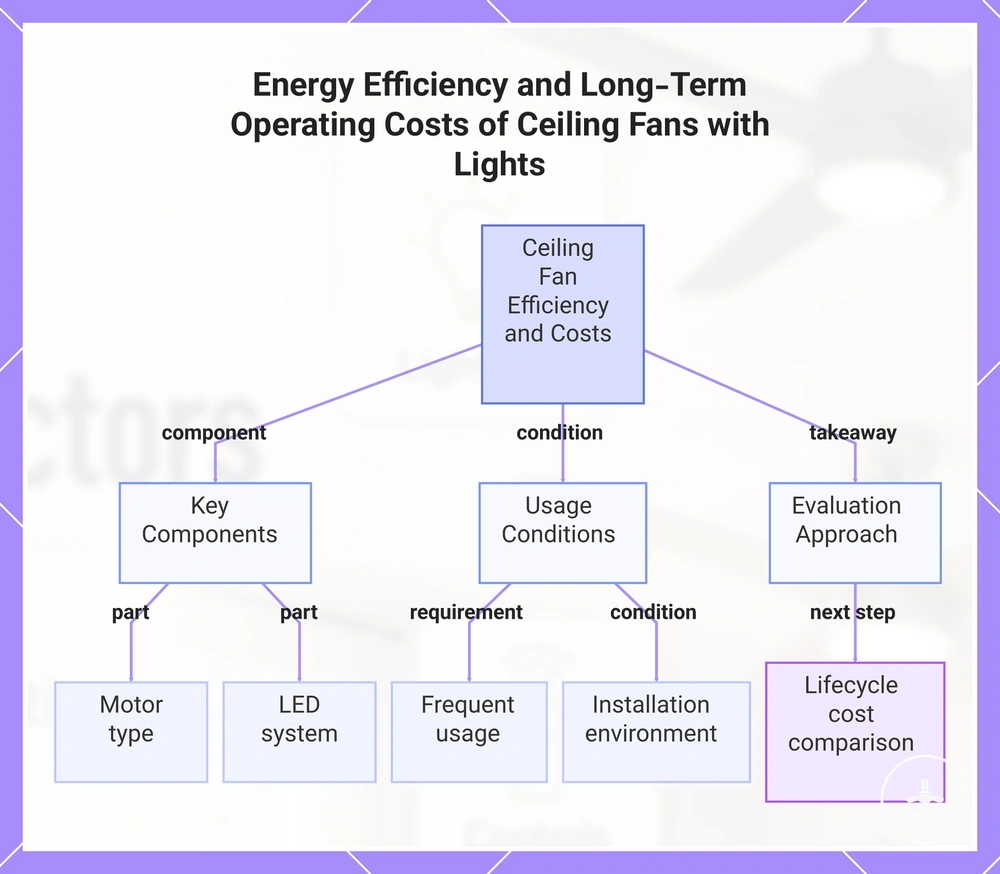
Long-term operating cost is driven by the electricity used by the fan motor and the light over the time each one operates. Efficiency matters more as operating hours rise, so a higher-efficiency motor or LED system has greater potential value in a frequently used room than in an occasional-use room.
A DC motor can reduce fan-side electricity use relative to less efficient motor designs, while LED lighting generally uses less electricity for a given lighting task than older incandescent or halogen lighting. Actual savings still depend on the wattage of the selected model, the hours used, and the electricity tariff. For lighting-specific factors, see LED light value factors.
Operating-cost calculation
Cost = ((fan watts × fan hours) + (light watts × light hours)) ÷ 1000 × electricity tariff per kWh
Dividing watt-hours by 1000 converts them to kilowatt-hours. Use the selected model’s stated wattage and your own tariff; calculate fan and light hours separately when they are not used for the same amount of time.
- Frequent use: efficiency can have a larger effect on cumulative operating cost.
- Occasional use: installation fit and purchase cost may carry more weight than small efficiency differences.
- Separate fan/light use: compare both loads rather than treating the product as one constant wattage.
This chart shows the components and usage conditions that influence long-term operating cost and how they fit into a value assessment.
Budget vs Premium Ceiling Fans with Lights Value Trade-offs and Performance Differences
Budget and premium fans represent different trade-offs, not guaranteed levels of quality. A budget model can be the better value when room requirements are simple; a premium model can justify a higher purchase cost when durability, efficiency, lighting quality, or control depth is both materially better for the chosen model and useful in the intended room.
The comparison should therefore hold the criteria constant. Premium styling alone does not establish better long-term value, and a lower price alone does not establish lower lifecycle cost. For a related lighting-design trade-off, see integrated light versus light kit value.
| Comparison factor | Budget option | Premium option |
|---|---|---|
| Construction and durability | Can be sufficient for straightforward or lighter-duty use; verify the actual model rather than assuming short life | May use more refined materials or construction, but durability still depends on the model and usage conditions |
| Efficiency | Often focuses on essential operation | More likely to offer higher-efficiency motor/control combinations where that is part of the specification |
| Lighting | Usually prioritises core illumination | More likely to add dimming, adjustment, or refined lighting features |
| Controls | Usually simpler and easier to justify when advanced control is unnecessary | May add remote, smart, or broader speed/light control options |
| Best-fit condition | Simple room need, lighter feature demand, or occasional use | Frequent use or specific performance, lighting, control, finish, or serviceability requirements |
Pay for the premium attribute, not the premium label. If the added attribute will not change comfort, convenience, energy use, or serviceability in the room, it contributes little practical value.
Feature Trade-offs in Ceiling Fans with Lights: DC Motor, LED Quality, and Smart Controls
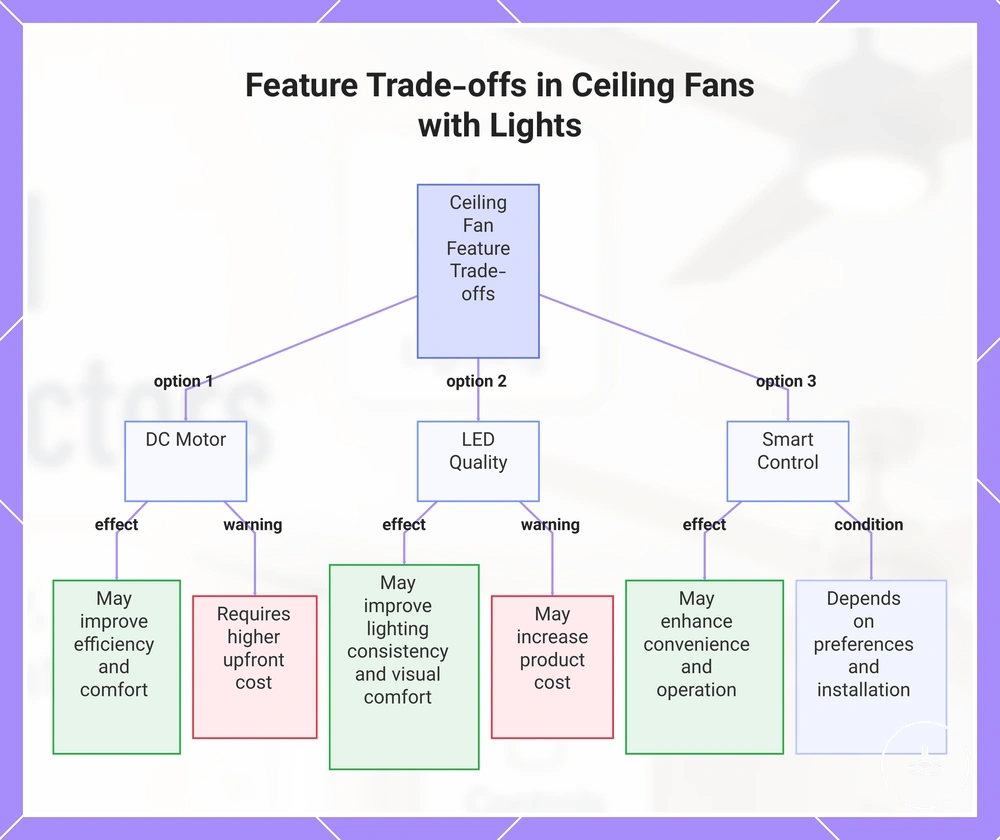
Feature upgrades change value only when the added capability is used. A DC motor, higher-quality LED system, or smart control can improve efficiency, lighting experience, or convenience, but each also adds cost or complexity that must be matched to a real requirement.
DC designs can support efficient, quiet, fine-grained speed control; LED quality affects brightness consistency, dimming, and visual comfort; smart control can make repeated speed and light adjustments easier when the installation and user preference support it. For additional control guidance, see control feature value.
| Feature | Potential benefit | Trade-off | Best-fit condition |
|---|---|---|---|
| DC motor | Efficient operation, broader speed control, and potentially quieter running | Can raise upfront product cost and uses its own control electronics | Frequent use, sensitivity to operating noise, or a need for finer speed adjustment |
| Higher-quality LED system | Better brightness control, dimming behaviour, and lighting comfort | More capable or integrated lighting can increase component cost and may affect future serviceability | Rooms where the ceiling light is used frequently or needs to serve more than simple on/off illumination |
| Remote or smart control | Convenient access to fan speed and lighting functions | Adds electronics and can add setup or compatibility considerations | Users who adjust settings often or need convenient control from multiple positions |
The useful comparison is not “more features versus fewer features”; it is required feature versus unused feature. Choose the extra capability only when its benefit matches the room and routine.
This chart visualises the main DC-motor, LED-quality, and smart-control trade-offs.
Replacement and Maintenance Costs for Ceiling Fans with Lights: Light Kits, LEDs, and Parts
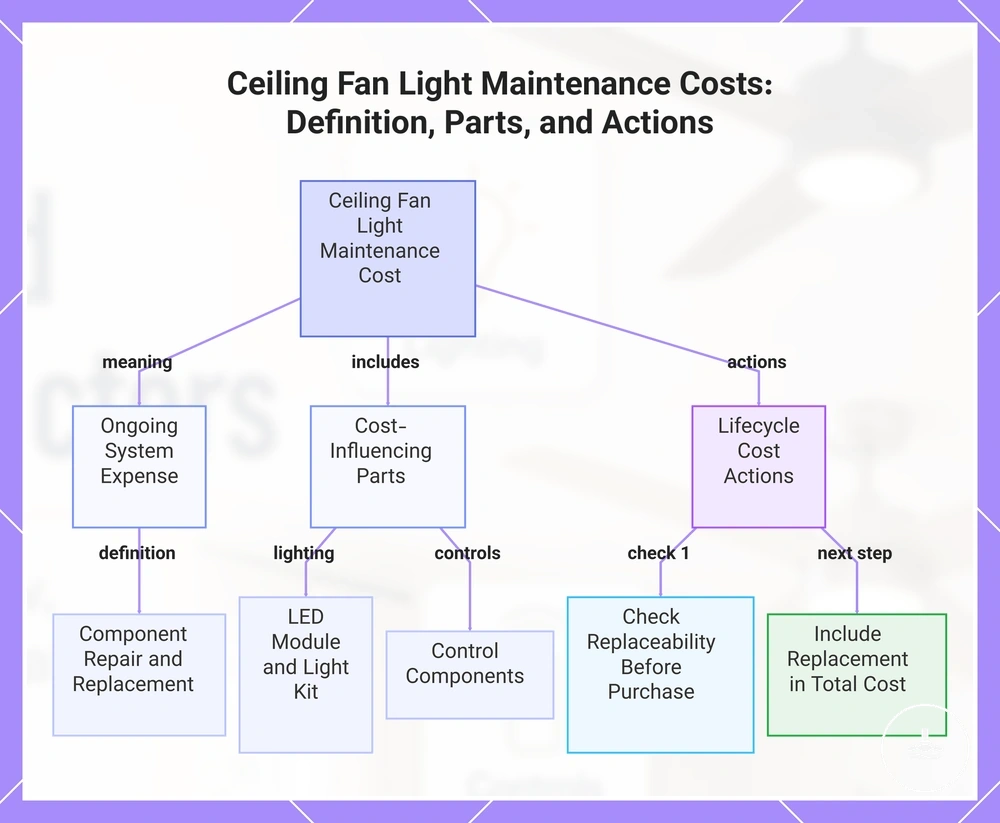
Maintenance cost is the part of lifecycle cost created after installation by service, repair, or replacement of lighting and control components. It cannot be reduced to one universal lifespan because component design, usage, operating conditions, and parts support differ by model.
Serviceability is therefore an important value attribute. An integrated LED module may require a model-specific replacement approach, a separate light kit may be easier to replace or upgrade on compatible designs, and remote/smart control components may also need service over time. For the lighting-design distinction, see integrated light versus light kit value.
| Lifecycle component | What to verify before purchase | Why it affects value |
|---|---|---|
| LED module | Whether the light source is replaceable or requires a model-specific module/service procedure | Failure can affect the lighting function even when the fan motor still operates |
| Light kit | Whether the kit is replaceable or upgradeable on the specific fan design | Replaceability can reduce the need to replace the whole fan when only the lighting part changes |
| Remote/control electronics | How the receiver/controller is serviced and whether compatible replacement parts are supported for the model | Control failure can remove convenient or essential operating functions |
| General serviceability | Access to model documentation, replaceable parts, and a practical service path | Better serviceability can lower disruption and avoid premature whole-unit replacement |
- Include likely maintenance and replacement needs when comparing total lifecycle cost.
- Do not assume an integrated component is permanently non-replaceable or that a separate kit is universally replaceable; verify the specific model.
- Use a buying checklist to compare serviceability alongside installation, efficiency, lighting, and controls.
This chart summarises maintenance-cost meaning, the parts that can create ongoing expense, and the actions that support lifecycle planning.