
Ceiling Fans with Lights for Living Rooms: Coverage, Brightness, and Style
The right ceiling fan with light for a living room is the one that fits the room before it fits a style preference: match fan scale and measured airflow to the occupied area, choose lighting that can cover everyday visibility and ambience, and confirm the mounting configuration suits the ceiling. In open-plan or high-ceiling rooms, give extra weight to circulation reach and mounting geometry; in compact or low-ceiling rooms, prioritise proportion and clearance.
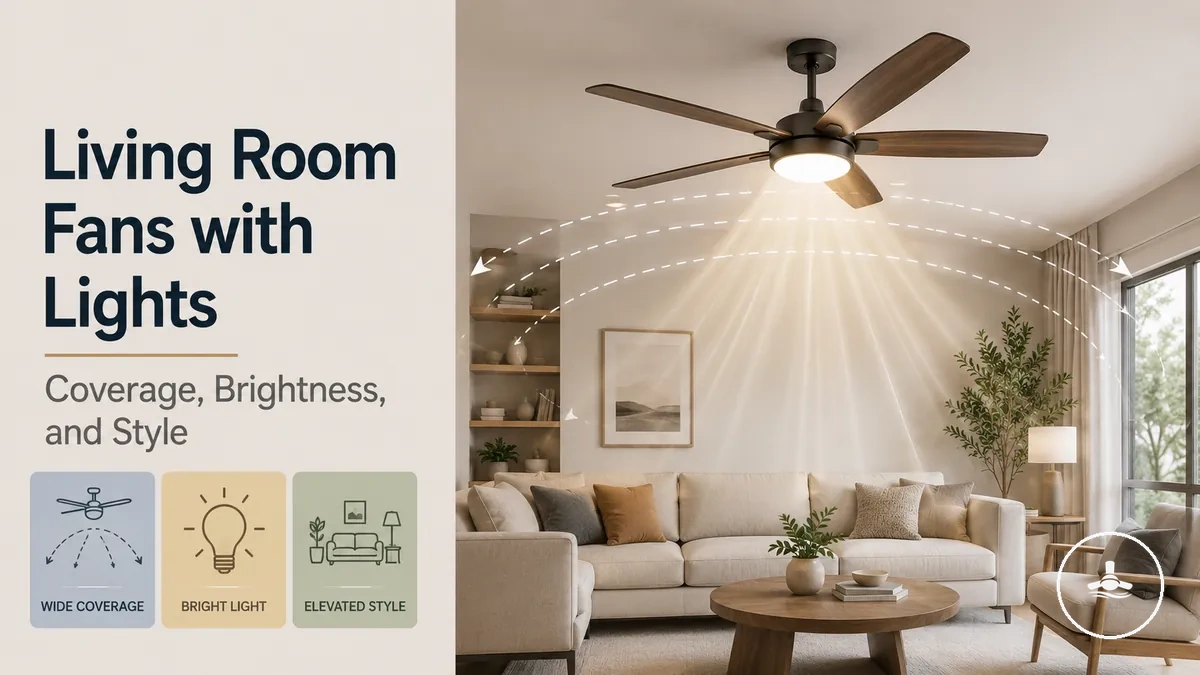
Living-room fan fit assistant
Use the room conditions below to build a practical fan profile. The result combines scale, airflow, lighting, mounting and style; it does not name a universal best model.
Suggested profile: A mid-scale fan profile with measured airflow suited to the occupied area, dimmable integrated lighting and a standard flat-ceiling mount.
- Compare manufacturer airflow ratings as well as blade span; a larger diameter alone does not guarantee stronger useful circulation.
- Prefer dimming for mixed living-room use so the same light can move from general visibility to softer evening ambience.
- Confirm model-specific blade-to-floor and surrounding clearances before installation.
- Use finish and blade form to support the room's existing visual language after functional fit is confirmed.
Final suitability remains model- and room-specific. Verify the fan's dimensions, rated airflow, light output, mounting instructions and required clearances before purchase or installation.
Evaluate the room in this order: fit and clearance → airflow coverage → lighting flexibility → visual integration. That sequence keeps decorative preference from masking a poor functional fit.
Living room ceiling fans with lights: scope, use cases and performance expectations
A ceiling fan with an integrated light serves two linked living-room tasks: moving air across the occupied zone and supplying general or ambient light from the same ceiling position. Its usefulness is not a fixed property of the fixture alone; it changes with room scale, layout, occupancy, ceiling geometry and the activity taking place.
What the fixture must do
The practical expectation is therefore balanced performance rather than maximum performance: stronger airflow is not automatically a better fit if the fixture is oversized, the light is uncomfortable, or the mounting geometry is unsuitable.
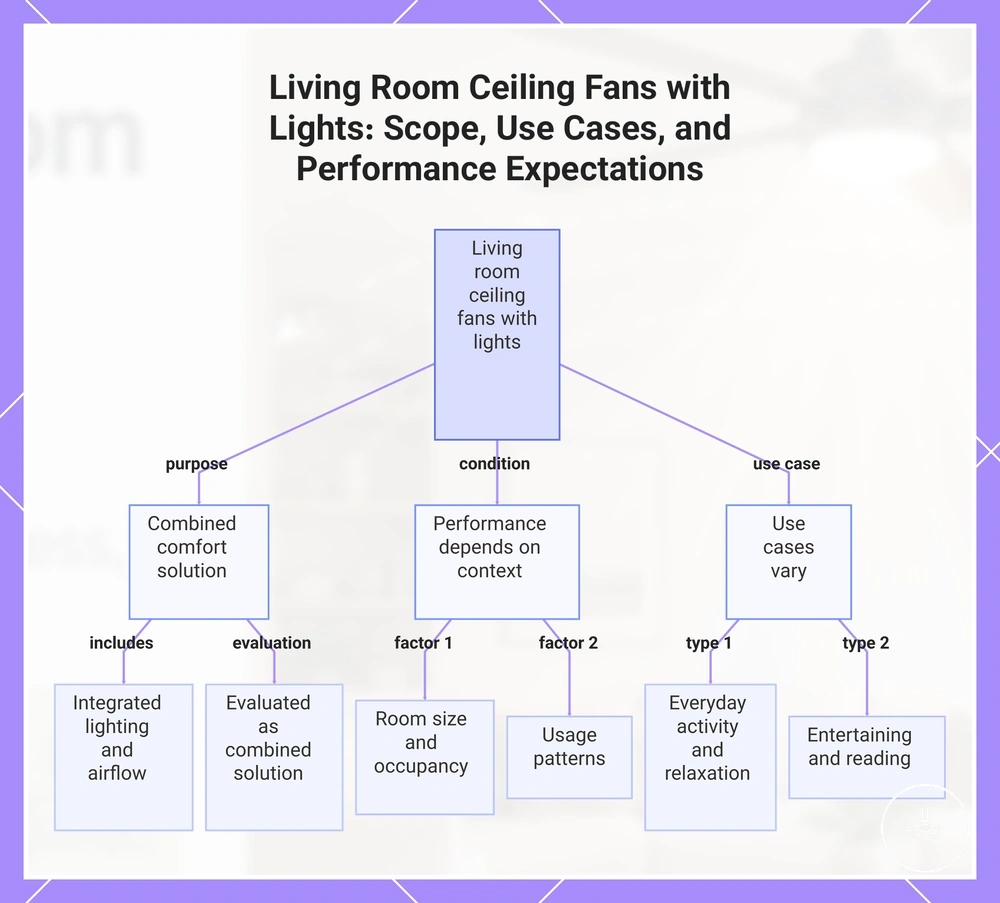
Airflow and comfort coverage for living rooms and open-plan spaces
Living-room airflow should be judged by where useful air movement reaches, not by blade span alone. The model-specific airflow rating, fan placement, room boundaries and connected spaces determine how evenly circulation reaches the occupied area.
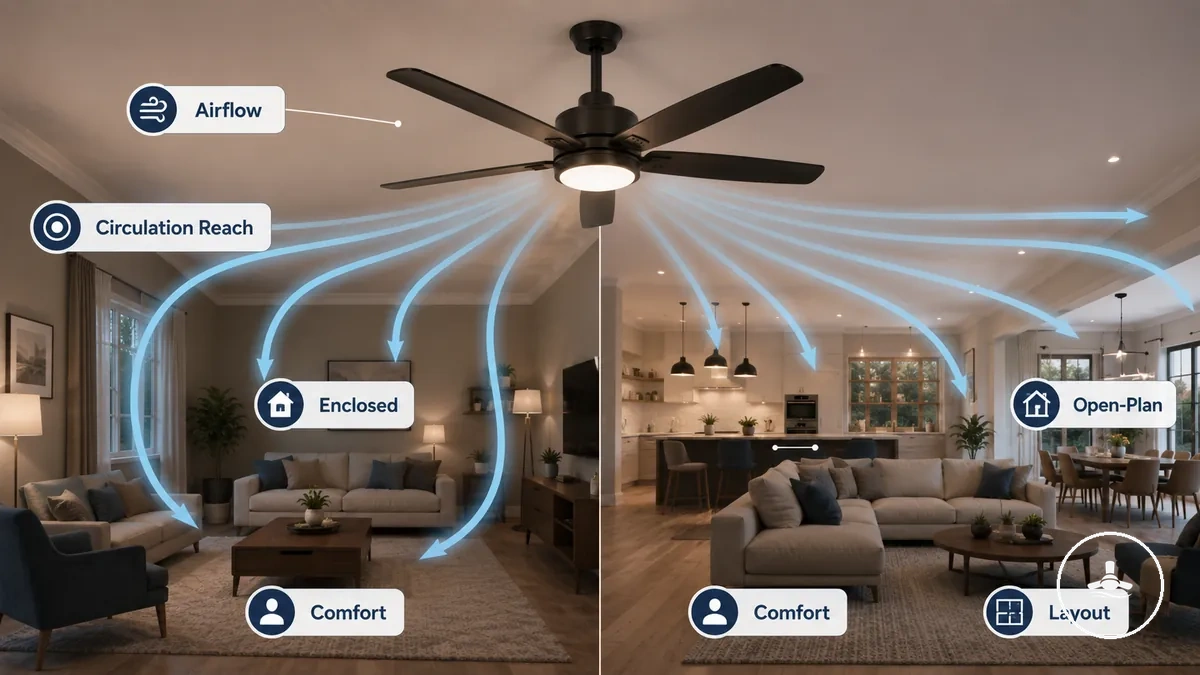
In an enclosed living room, air movement is usually more contained by walls. In an open-plan area, the same fan output is shared across a broader connected space, so rated airflow and placement carry more weight. Compare airflow figures under the same manufacturer test basis where possible, and use airflow for larger rooms when circulation across a large connected area is the dominant requirement.
A useful decision rule is to favour the configuration that reaches the main occupied zone consistently. If one seating area receives strong air movement while adjoining occupied areas receive little, the room may need a different fan position, a higher-capacity profile, or more than one circulation source rather than simply a visually larger fan.
Lighting brightness and ambience for everyday living room use
Integrated lighting should be evaluated by light output, colour temperature and control range. Use lumens—not LED wattage alone—to compare light output, and prefer dimming when the living room alternates between general visibility, reading, entertaining and relaxed evening use.
| Living-room use | Brightness direction | Colour appearance | Useful control |
|---|---|---|---|
| Relaxing / TV | Lower, glare-controlled ambient level | Warm white, about 2700–3000 K, often feels softer | Dimming is especially useful |
| General household use | Moderate whole-room visibility | Warm to neutral white | Dimming allows day-to-evening adjustment |
| Reading / detailed tasks | Higher local visibility | Neutral white, roughly 3000–4000 K, can improve visual clarity | Use the fan light with task lighting when one ceiling source is not enough |
| Entertaining | Variable according to activity | Choose a tone that complements the room finishes | Independent or flexible light control is preferable |
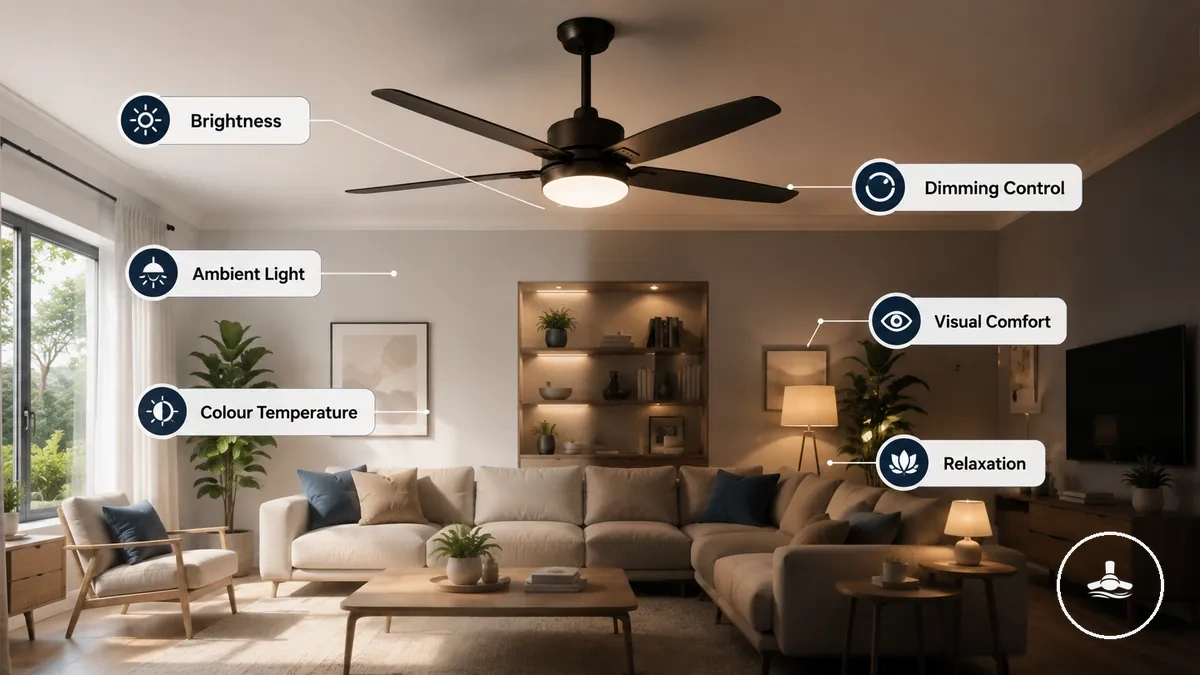
There is no single lumen value that suits every living room because usable brightness changes with room area, ceiling height, surface reflectance, natural light and whether other lamps are present. The practical test is whether the integrated light provides the required visibility without becoming the room's only inflexible light source. See living room brightness planning for a deeper lighting-focused comparison.
Design and style integration for modern and decorative living rooms
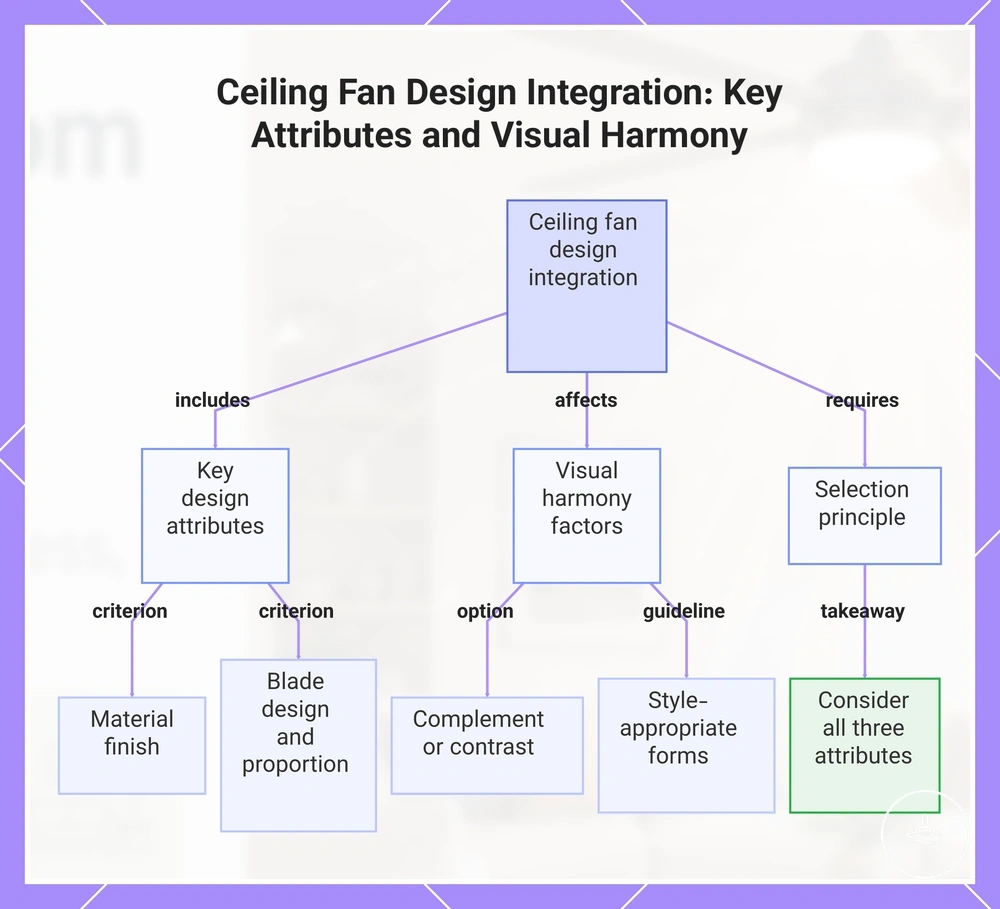
Design fit is a compatibility question: the fan should look intentional at the room's scale without overpowering the practical requirements. Evaluate finish, blade form and visual weight against the room's furniture, hardware, lighting and architectural lines.
Modern living rooms often suit restrained forms and simple finishes, while decorative rooms can accommodate more expressive shapes or materials. Neither is inherently better: the better fit is the option whose scale and finish support the room without compromising airflow, lighting or clearance. For broader selection by priority, see best ceiling fans with lights by priority.
Ceiling height, room layout and installation fit in living rooms
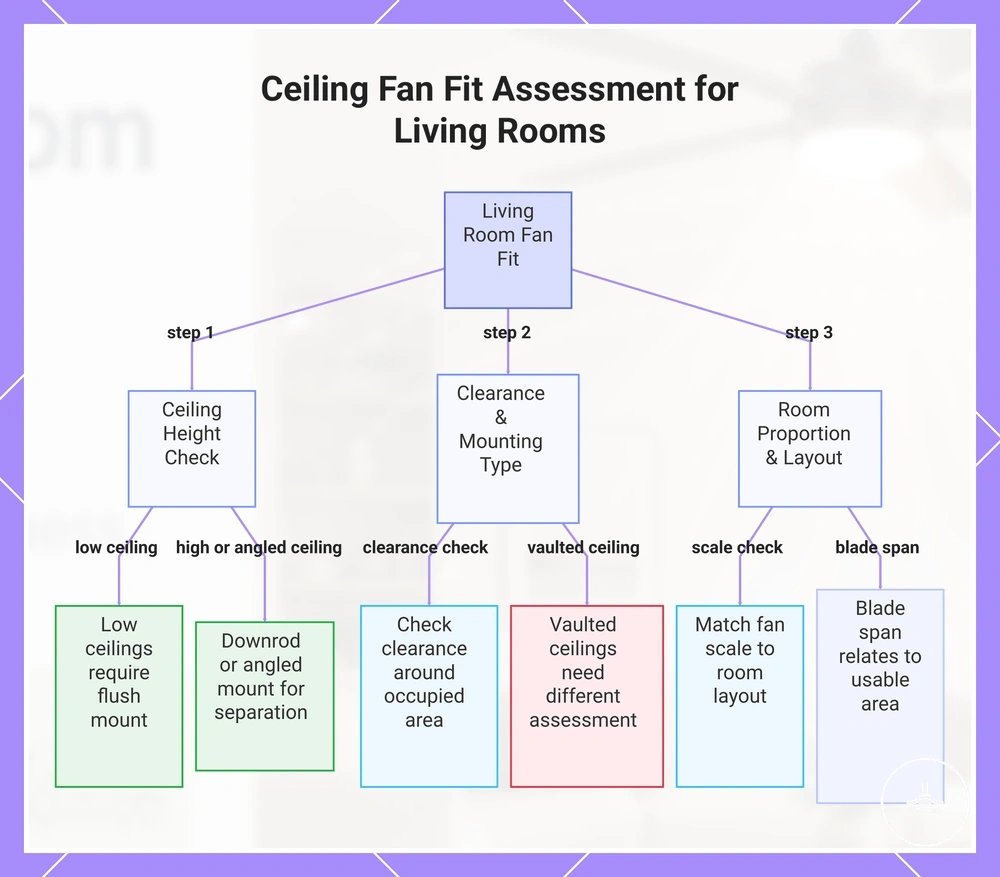
Installation fit begins with the ceiling condition. The correct mounting profile is the one that keeps the fan within the manufacturer's required clearances, positions the blades appropriately for the room, and remains compatible with the ceiling structure.
| Ceiling / room condition | Mounting direction | What to verify |
|---|---|---|
| Low or clearance-constrained ceiling | Consider a low-profile or close-to-ceiling model | Blade-to-floor clearance, total fixture drop and whether the model is approved for that mounting orientation |
| Ordinary flat ceiling | Standard mount may be suitable | Fan drop, surrounding clearance, occupied-zone alignment and access to the electrical point |
| High ceiling | A compatible downrod may place the fan closer to the occupied zone | Manufacturer-approved downrod length, structural support and resulting blade height |
| Angled / vaulted ceiling | Use a model and mounting system designed for the ceiling angle | Maximum supported angle, downrod compatibility and blade clearance across the slope |
- Confirm the ceiling structure can support the specific fan and mounting hardware.
- Verify blade-to-floor, blade-to-wall and obstacle clearances from the manufacturer's installation instructions.
- Check that doors, tall furniture and circulation paths do not conflict with the fan's sweep or hanging light.
- For angled ceilings, use vaulted ceiling fan fit guidance rather than assuming a standard mount will articulate far enough.
- Relate fan scale to the usable room area with room coverage and blade span, but confirm performance with the fan's airflow specification.
Mounting fit is a prerequisite, not a styling preference. If a chosen configuration cannot meet model-specific clearance and structural requirements, select a different mounting profile or fan rather than forcing the installation.
Choosing the right ceiling fan with light for your living room
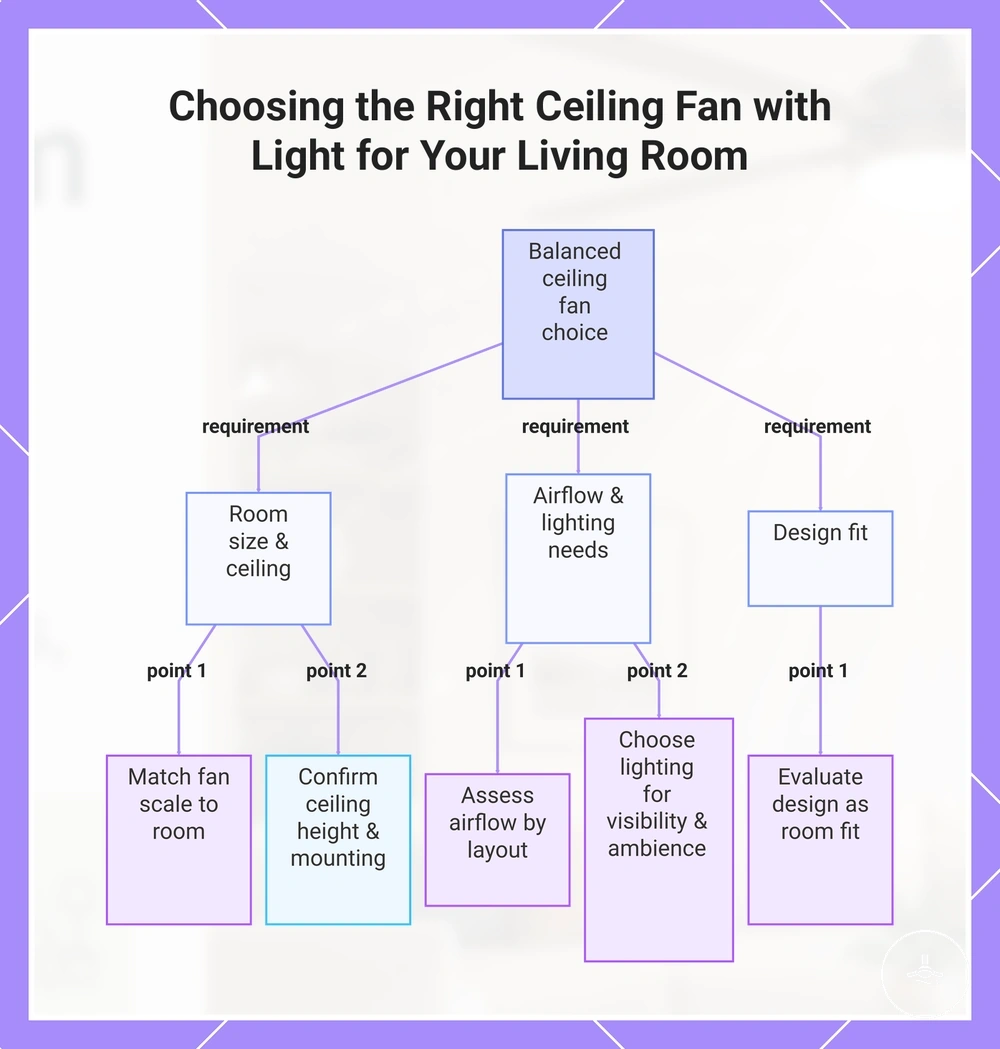
Choose by eliminating poor fits first, then comparing comfort and design. A useful sequence is room scale → airflow requirement → lighting requirement → ceiling compatibility → design fit. This keeps a visually attractive fan from winning before its functional constraints are checked.
- Define the occupied area. Decide whether the fan must serve one enclosed living room or contribute to a larger open-plan zone.
- Compare airflow performance. Use the manufacturer's airflow rating and speed range, not blade span alone, to judge circulation capability.
- Define the lighting job. Decide whether the integrated light is mainly ambient, general-purpose or part of a layered task-lighting plan; prefer dimming for mixed use.
- Confirm mounting compatibility. Check ceiling type, total drop, clearances and the fan's approved mounting options before comparing finishes.
- Finish with visual integration. Choose the finish and blade design that fits the room once the functional profile is acceptable.
This framework is intentionally conditional: a large open-plan living area may weight airflow more heavily, while a compact room may weight proportion and clearance more heavily. For category-level alternatives, see ceiling fans with lights.
Standard living rooms vs open-plan living areas airflow behaviour
The same fan can feel different in an enclosed room and an open-plan area because the boundaries change how air movement spreads. Use the comparison below to interpret circulation reach and comfort uniformity rather than treating layout type as a quality ranking.
| Airflow attribute | Enclosed living room | Open-plan living area |
|---|---|---|
| Physical boundary | Walls contain the primary circulation zone | Air movement can continue into adjoining spaces |
| Circulation reach | More concentrated within one defined room | Shared across a broader connected area |
| Comfort uniformity | Easier to evaluate within a single seating / activity zone | Depends more strongly on fan position, connected-zone size and airflow capacity |
| Selection emphasis | Room fit and local coverage | Rated airflow, placement and broader coverage |

Sizing priorities for small, medium and large living rooms
Blade span should increase only when the room and airflow requirement justify it. Because manufacturers use different motors, blade geometry and test methods, blade span is a sizing cue rather than a direct airflow guarantee.
| Living-room scale | Starting fan profile | Primary check | When to move up |
|---|---|---|---|
| Small / compact | Compact blade span and low visual mass | Proportion, clearances and useful low-speed airflow | If the occupied area is wider than the effective circulation zone |
| Medium | Mid-size span with a broad usable speed range | Balance between measured airflow, light output and room proportion | If the room has a long footprint, high ceiling or connected opening that weakens coverage |
| Large | Larger-span, higher-capacity profile or multiple-fan planning | Measured airflow across the actual occupied area | When one fan cannot distribute air consistently across the main zones |
Use room coverage and blade span as the dimensional starting point, then confirm the shortlisted model's rated airflow and installation geometry. Do not choose the largest fan that physically fits by default.
Balancing airflow performance and lighting requirements for living room comfort
Airflow and lighting are separate outputs sharing one fixture, so the useful balance changes with the activity. The goal is not to maximise both at all times; it is to choose a fan whose speed range and light controls can move between the room's common use cases.
| Use case | Airflow priority | Lighting priority | Best control characteristic |
|---|---|---|---|
| Quiet relaxation / TV | Low to moderate, steady circulation | Lower, glare-controlled ambience | Low-speed stability plus dimming |
| Reading | Comfortable circulation without distracting draught | Higher local visibility | Dimming plus separate task light when required |
| Entertaining | Moderate to higher according to occupancy and weather | Flexible whole-room visibility | Independent fan-speed and light control |
| Warm-weather daytime use | Higher circulation priority | Only as much artificial light as the room needs | Wide fan-speed range; dim or switch the light independently |
Energy use is easiest to manage when fan speed and light output can be adjusted independently rather than run at maximum by default. Compare living room brightness planning alongside airflow performance if the fan will serve as a major room light.