
Ceiling fans with lights as a category combining airflow, lighting, controls, and room fit considerations
Choose a ceiling fan with light by matching blade span and airflow to room size, light output and colour temperature to the room’s lighting task, control type to how you want to operate it, and mounting style to ceiling height and slope. A balanced fit matters more than any single feature: unsuitable sizing, weak lighting, incompatible controls, or the wrong mounting arrangement can undermine the combined fixture.
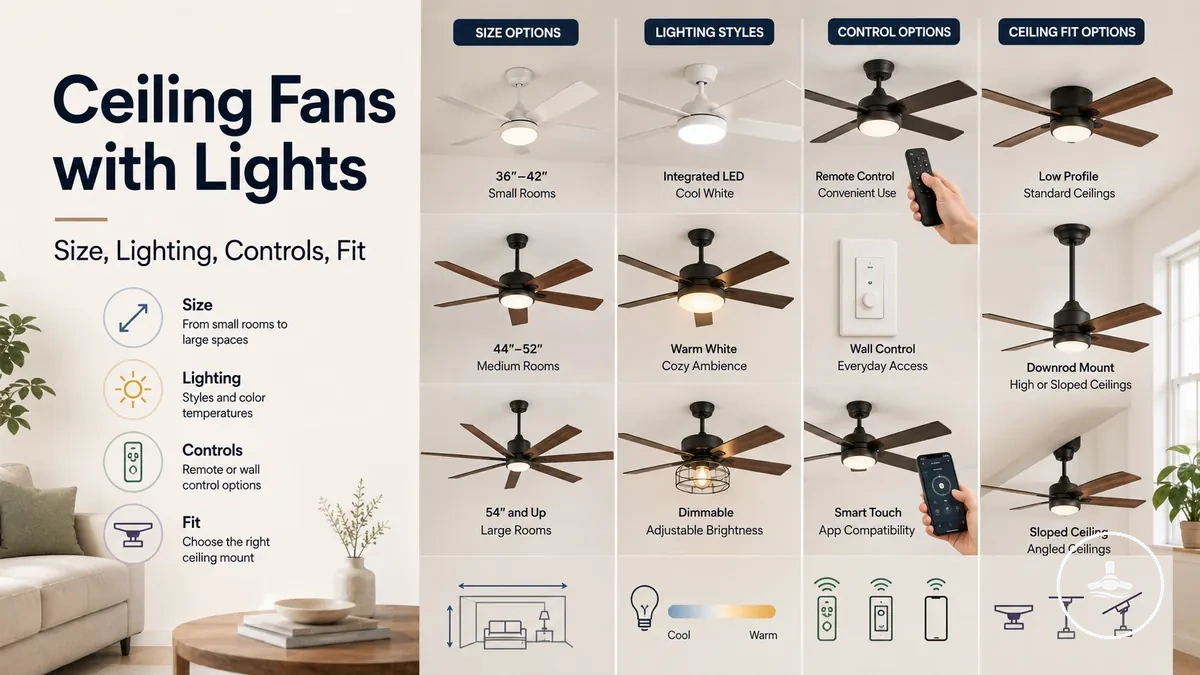
Quick fit decision assistant
Use four stable criteria to create a starting profile. The result is a selection guide, not a model-specific installation approval: always confirm the chosen fan’s published airflow, light specifications, mounting limits, and installation instructions.
Bedrooms often place more weight on quiet operation, controllable low light, and convenient access to controls; living areas usually place more weight on wider airflow coverage and brighter general lighting. The sections below separate the system into its main attributes so each one can be checked before a model is selected.
What ceiling fans with lights are and how they function as combined airflow and lighting solutions
A ceiling fan with a light combines two functions in one ceiling-mounted fixture: the motor and blades move room air, while an integrated LED module or light kit provides illumination. The systems share a mounting point and housing, but compatible controls can operate fan speed and light output independently.
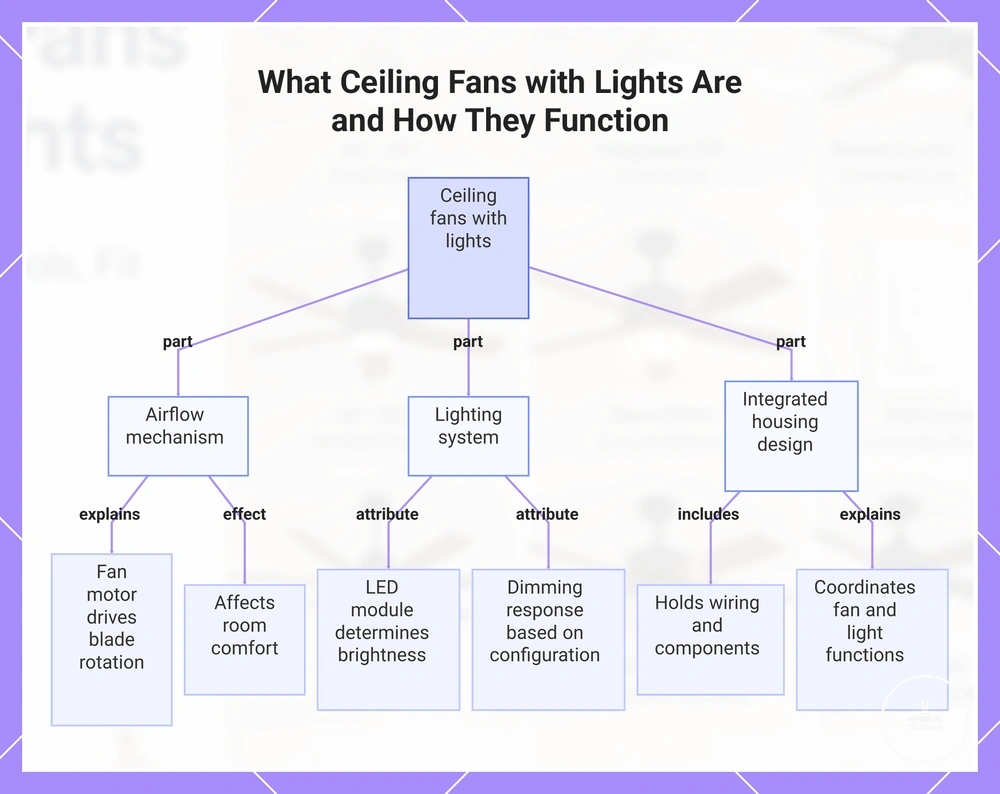
The combined fixture is easiest to evaluate as four connected parts rather than as a single feature.
| Part | Primary attribute | Value or state to check | Practical implication |
|---|---|---|---|
| Motor and blades | Air movement | Speed settings and the model’s published airflow, often stated in m³/min or CFM | Match actual airflow performance to the room; blade count alone does not establish airflow. |
| LED module or light kit | Illumination | Lumen output, colour temperature, dimming support, and serviceability | Choose the light for the room’s general-lighting and ambience needs, not by wattage alone. |
| Control system | User interaction | Remote, wall, smart, or combined control; separate fan/light commands where required | Control type should match daily access, automation needs, and installation constraints. |
| Housing and mount | Ceiling fit | Low-profile, standard, or slope-compatible arrangement according to the model | The mounting system must suit ceiling geometry and a support point intended for fan loads. |
The diagram below shows how these parts share one fixture while performing distinct airflow, lighting, control, and mounting roles.
Key benefits and limitations of ceiling fans with lights for different room environments
The main benefit of a ceiling fan with a light is functional consolidation: one ceiling position can provide air movement and general illumination, often through one control system. The main limitation is the same integration: fan size, lighting quality, serviceability, controls, and mounting all have to suit the same room.
Benefits
- Combines circulation and general lighting where both are needed at the same ceiling position.
- Can simplify daily operation when fan speed and lighting are available from one remote, wall control, or supported smart interface.
- Works well in bedrooms and living areas when blade span, airflow, and light output are matched to the room.
- Dimmable lighting can extend one fixture from brighter general use to lower-light evening use.
Limitations
- An integrated light may not replace dedicated task or accent lighting in rooms with higher lighting demands.
- A poor room-size match can leave airflow uneven even when the fan physically fits.
- Low or sloped ceilings can restrict mounting choices and require model-specific hardware.
- Integrated LED modules and smart controls can be less straightforward to service or replace than simple, separate fixtures.
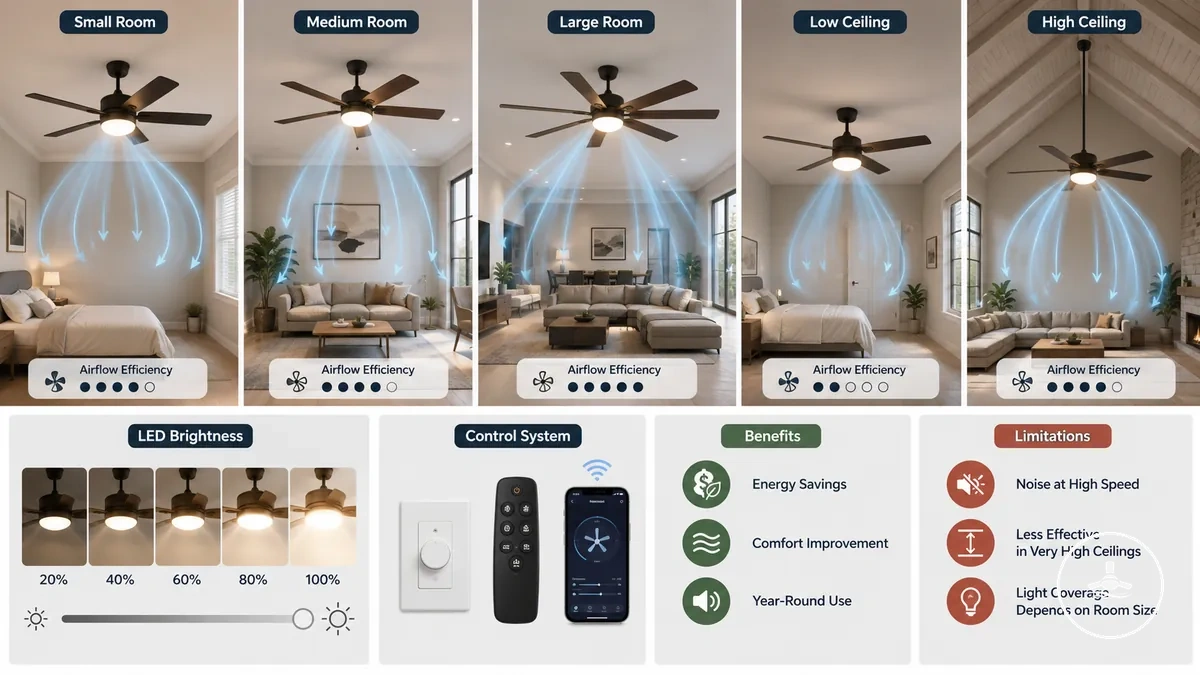
A combined fan-light is therefore strongest when both functions are genuinely useful in the same room and the fixture can meet the room’s airflow, lighting, and mounting requirements without forcing a compromise in one of them.
How to choose ceiling fans with lights based on room needs, usage goals, and selection criteria
Choosing a ceiling fan with a light is a constraint-matching task. Start with the room and ceiling, then evaluate lighting and controls; this prevents a convenient feature from distracting from a basic sizing or mounting mismatch.
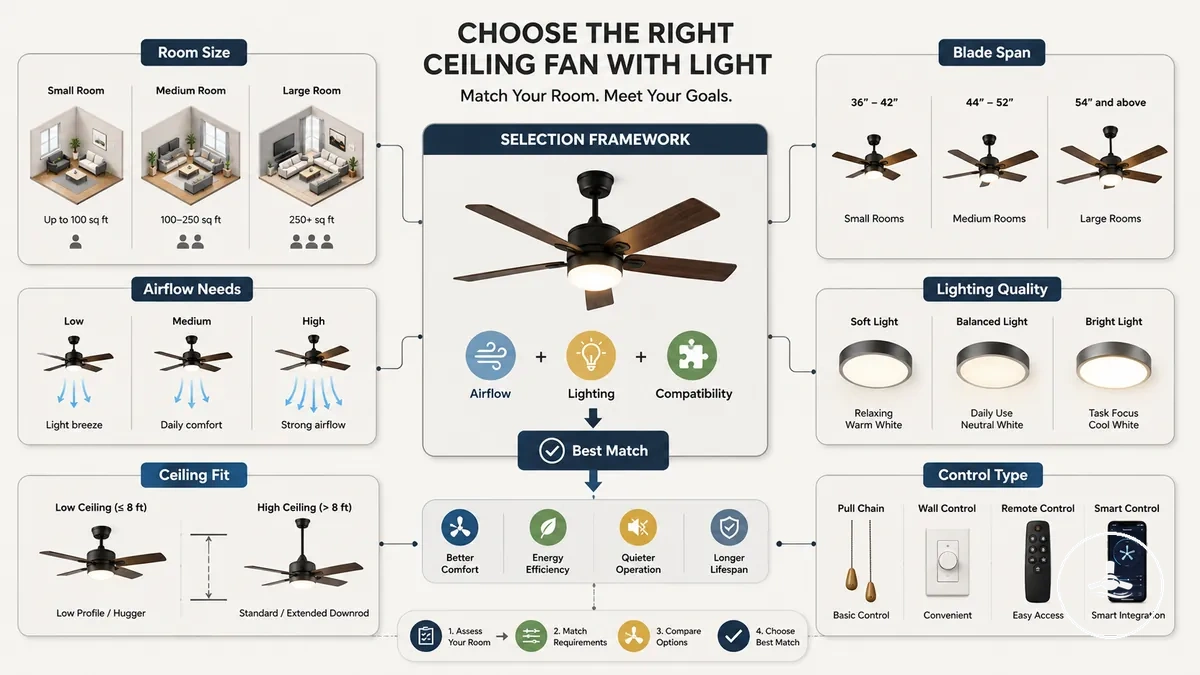
- Measure the room. Use floor area and room shape to choose a starting blade-span range, then compare the model’s published airflow rather than assuming span alone guarantees performance.
- Check the ceiling. Confirm ceiling height, slope, mounting point, and whether the model supports low-profile, standard, or slope-compatible installation.
- Define the lighting task. Compare lumen output, colour temperature, dimming support, and whether the integrated light is enough for general lighting or will be supplemented by task lighting.
- Choose the control method. Decide whether remote, wall, or smart control is preferable and verify the fan and light can be controlled in the way you expect.
- Verify the complete model specification. Check installation instructions, airflow, light specifications, control compatibility, and any model-specific mounting limits together before purchase.
The buying checklist for ceiling fans with lights can be used as a final verification pass. The key rule is to eliminate incompatible size or ceiling configurations before comparing convenience features.
Ceiling fan size and room coverage requirements for balanced airflow and comfort
Room area gives a useful starting point for blade span, but blade span is not a direct measure of airflow. Motor design, blade geometry, speed, room shape, and installation height also affect how air moves, so the model’s published airflow should be checked alongside physical size.
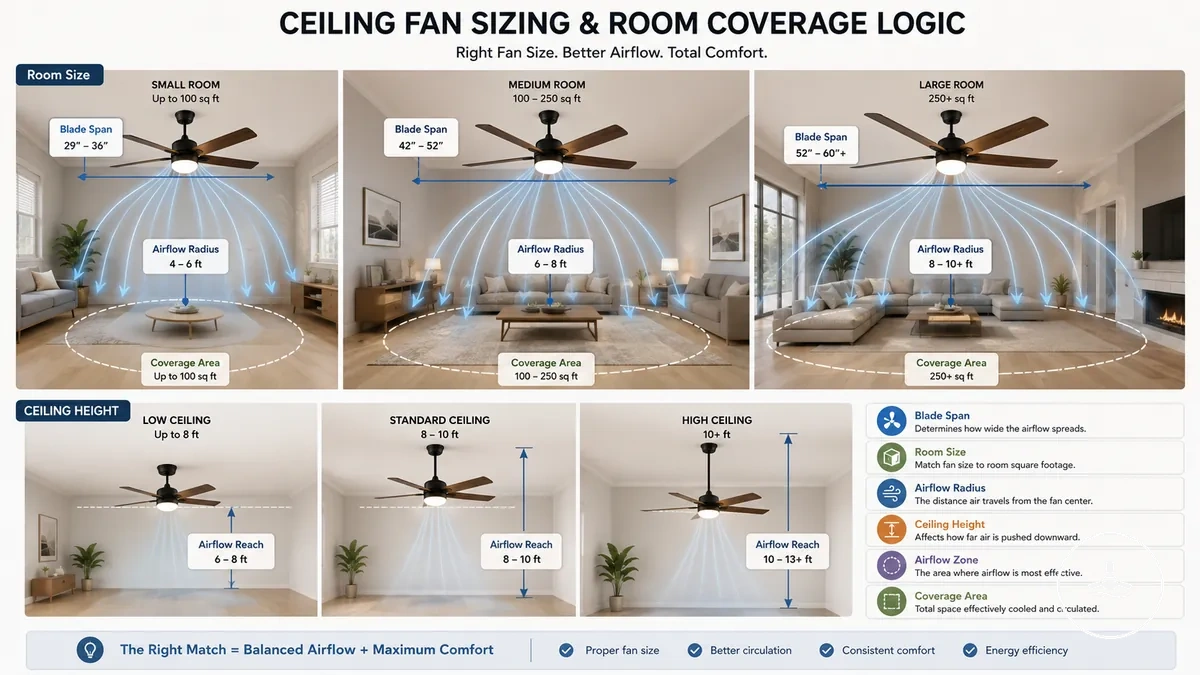
The ranges below are practical starting bands for typical residential rooms, not universal limits. Use the fan manufacturer’s room-size and installation guidance when it differs.
| Room floor area | Typical blade-span starting range | How to interpret it |
|---|---|---|
| Under 10 m² | about 90–122 cm | Suitable as a compact starting range for small bedrooms, studies, or similar rooms when clearances allow. |
| 10–20 m² | about 122–132 cm | A common mid-size range; compare published airflow if the room is long, crowded, or open to adjacent space. |
| 20–30 m² | about 132–142 cm | Wider spans are often useful, but airflow specification and room shape become increasingly important. |
| Over 30 m² or long/open-plan | 142 cm+ or multiple fans may suit | Do not rely on span alone; verify the model’s airflow coverage and consider whether more than one fan gives better distribution. |
Ceiling height changes the mounting arrangement and how airflow is felt in the occupied zone. For unusually high, low, irregular, or open-plan spaces, treat the table as a starting filter rather than a final sizing rule.
Lighting performance factors including brightness, colour temperature, LED types, and dimming behaviour
The light in a ceiling fan should be evaluated as a lighting system, not merely as an included feature. The most useful attributes are lumen output, colour temperature in kelvins (K), dimming compatibility, and the way the LED source can be serviced or replaced.
| Lighting attribute | Useful value or condition | Effect on selection |
|---|---|---|
| Brightness | Compare lumens; required output depends on room size, surfaces, and whether the fan light is the main source or one layer of lighting. | Lumens describe usable light output more directly than electrical wattage. |
| Colour temperature | 2700–3000 K appears warm; 3500–4000 K appears neutral; 5000 K and above appears cooler/daylight-like. | Choose the tone for ambience and visual task; colour temperature does not by itself indicate brightness. |
| Dimming | Requires a dimmable LED driver/module and a compatible control method. | Dimming lets one fixture cover brighter general use and lower-light evening use. |
| LED form | Integrated LED module or replaceable lamp/light kit, depending on the model. | Integrated modules can be compact, while replaceable lamps may make future servicing simpler. |
For relaxed rooms, warmer colour temperatures and smooth dimming are often useful. For spaces that need detailed visual work, prioritise adequate lumen output and consider separate task lighting rather than expecting the fan light to perform every lighting role.
Control options for ceiling fans with lights including remote, wall-mounted, and smart systems
Controls are the interaction layer for fan speed and lighting. Remote, wall, and smart systems can all work well; the best choice depends on access, installation effort, and the level of automation you actually need.
| Control type | Best-fit condition | Main trade-off | Verify before choosing |
|---|---|---|---|
| Remote control | You want handheld access and convenient fan/light adjustment from different parts of the room. | The remote can be misplaced and relies on its receiver, signal method, and batteries. | Confirm separate fan/light functions, dimming if required, and receiver compatibility. |
| Wall control | You prefer a fixed, predictable control point and do not need app-based operation. | It may require compatible wiring or a model-specific wall controller. | Confirm the wall control is designed for the selected fan and supports the required light functions. |
| Smart control | You want scheduling, app control, voice-platform integration, or automation. | Setup is more complex and some functions can depend on a network, app, account, or supported platform. | Confirm official platform support, available fan/light functions, and a practical manual fallback. |
Do not assume that adding a generic smart switch is safe or compatible with every fan motor or LED driver. Use the control method specified or supported for the selected model, especially where speed control or dimming is involved.
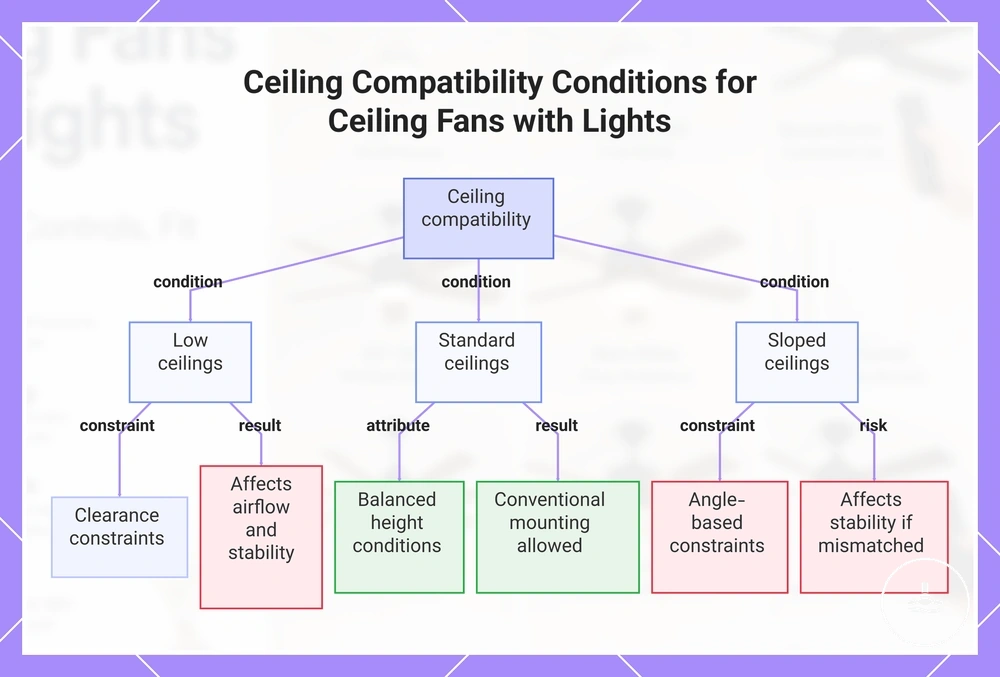
Ceiling compatibility factors including low ceilings, sloped ceilings, and mounting constraints
Ceiling compatibility determines whether a fan-light can be mounted at the intended position without compromising support, clearance, or level alignment. The decisive attributes are ceiling height, ceiling slope, mounting method, and the model’s stated limits.
| Ceiling condition | Mounting priority | What to check | Practical outcome |
|---|---|---|---|
| Low ceiling | Low-profile or close-to-ceiling configuration where the model allows it | Manufacturer minimum clearances, finished fan depth, blade position, and structural support | Preserves headroom while keeping the fan within its approved operating geometry. |
| Standard flat ceiling | Standard mount or compatible short downrod | Support point, mounting hardware, blade clearance, and recommended installation height | Usually provides the broadest model choice when the support and clearances are suitable. |
| Sloped or high ceiling | Slope-rated adapter and/or compatible downrod as specified by the manufacturer | Maximum supported slope, downrod compatibility, wiring length, and final fan level | Keeps the fan level and positions it more effectively in the occupied room zone. |
The diagram below summarises how low, standard, and sloped ceilings change the mounting decision.
Installation requirements and safety considerations for ceiling fans with integrated lighting
Installation readiness has three core constraints: fan-rated structural support, suitable electrical wiring and controls, and adequate spatial clearance. A ceiling point intended only for a light fitting should not be assumed to support the dynamic load of a ceiling fan.
| Check | Pass condition | If the condition is not met |
|---|---|---|
| Mounting support | The fixing point and hardware are intended to carry the selected fan and its operating loads. | Upgrade or relocate the support before installation; do not rely on a light-only fixing. |
| Electrical supply | Wiring, switching, earthing, and any controller/receiver arrangement match the fan-light requirements. | Have the circuit and control arrangement assessed before connecting the fixture. |
| Ceiling and blade clearances | The installed fan remains within the manufacturer’s stated spatial and mounting limits. | Choose a different mount, downrod, fan profile, or position rather than forcing the installation. |
| Mounting hardware | Brackets, downrods, adapters, fasteners, and slope components are compatible with the selected model. | Use model-approved or manufacturer-specified hardware. |
| Final operation | The fan is secure, level, free from abnormal wobble or contact, and fan/light controls operate as intended. | Stop use and correct the installation or component issue before normal operation. |
Cost and value factors influencing the selection of ceiling fans with lights
Value is not determined by price tier alone. A ceiling fan with a light offers better value when its airflow, lighting, controls, serviceability, and installation fit match the room with minimal unnecessary complexity.
| Value factor | A simpler option can be enough when | Paying more can add value when |
|---|---|---|
| Motor and airflow | The room is modest in size and a basic model already provides the required airflow at acceptable noise and power use. | The fan will run frequently, the room is larger, or you need better airflow control and quieter operation. |
| Lighting | The fan light is secondary and a fixed colour temperature with adequate lumen output meets the need. | The integrated light is used heavily and you benefit from dimming, selectable colour temperature, or easier serviceability. |
| Controls | Simple remote or wall control covers daily fan and light operation. | Automation, scheduling, app integration, or more granular fan/light control is genuinely useful. |
| Installation fit | The ceiling accepts the standard mounting arrangement without extra hardware or structural work. | A high, sloped, or constrained ceiling requires compatible downrods, slope hardware, or a specialised low-profile design. |
| Serviceability | Replacement parts and the lighting system are straightforward for the expected ownership period. | Long-term access to replaceable components, documented support, or a more serviceable lighting design reduces ownership friction. |
The best-value choice is the least complex configuration that fully satisfies the room’s airflow, lighting, control, and ceiling-fit requirements. Current prices, seller terms, warranty details, and availability should be checked at the actual retailer or manufacturer because those values can change independently of the product’s stable technical attributes.